Why delegation of decisions often backfires
We’ve all seen it happen. A manager assigns a decision, but somehow the questions, clarifications, and escalations pile up — until the manager ends up making the decision anyway. It’s not incompetence; it’s uncertainty.
Most people don’t hesitate to take on work. They hesitate to take on risk. When authority, expectations, or feedback loops are unclear, delegation creates confusion instead of freedom.
Delegation isn’t abdication. It’s structured trust.
What The One Minute Manager teaches about decision delegation
Ken Blanchard and Spencer Johnson’s The One Minute Manager has been a leadership classic for decades because it turns complex management theory into simple repeatable habits:
One Minute Goals — Set clear expectations.
One Minute Praisings — Reinforce success immediately.
One Minute Redirects — Correct issues quickly and constructively.
When applied to decision-making, these principles translate beautifully:
Define the decision clearly and who owns it.
Recognize and celebrate when people decide confidently.
Step in early when a decision is drifting, not after it fails.
Good delegation feels like coaching, not controlling.
Three foundations for effective delegation
1. Clarity of authority
People need to know what they can decide and what’s off-limits. Ambiguity kills initiative faster than mistakes ever will.
2. Safety for mistakes
Delegation only works when it’s safe to fail small. If people fear retribution, they’ll bring every micro-decision back to you.
3. Visibility of progress
Stay informed without micromanaging. When decisions are visible — documented, timestamped, and shared — you can guide from context instead of chasing updates.
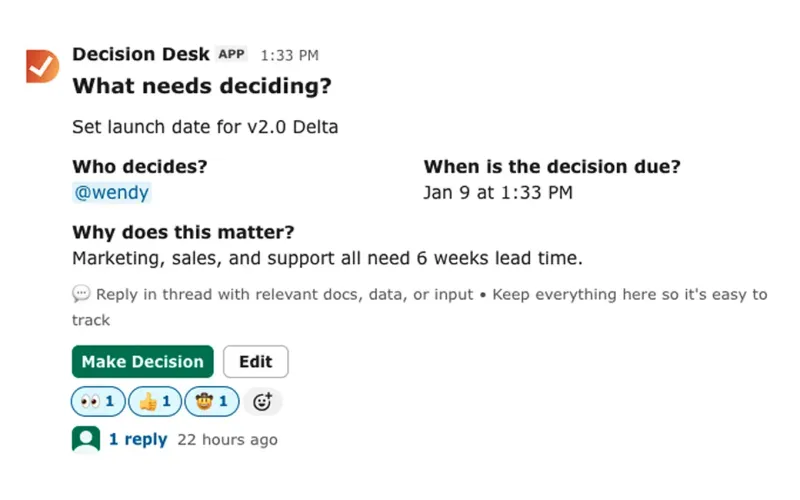
💡 Pro tip: In Decision Desk, delegated decisions remain visible to everyone. Owners update status directly in Slack, so accountability is transparent without extra meetings.
Step-by-step: How to hand off a decision
State the decision clearly.
“Decide which vendor will manage our Q2 localization project.”
Set success criteria.
“Chosen vendor must support Korean language, weekly syncs, and 24-hour turnaround.”
Confirm ownership and boundaries.
“You make the call, but loop in Procurement and Engineering for feedback.”
Establish visibility.
“Post your final summary in the Slack channel once chosen so the team knows.”
Close the loop.
“Once it’s done, share the reasoning — it builds context for future decisions.”
💡 Pro tip: A short decision title works wonders — Select vendor for Q2 localization — instantly clear and searchable.
How to prevent delegated work from circling back
Delegation collapses when people over-escalate. Here’s how to prevent that spiral:
Be explicit about authority. Don’t just say “You own it” — define what ownership means.
Avoid shadow approval. If every step still needs your sign-off, you haven’t delegated.
Keep decisions public. When updates are visible, people feel supported, not abandoned.
Follow up only for learning. Post-decision reviews build capability and confidence.
We’ve learned that when people understand both their decision space and the safety net behind it, they rarely need to bounce decisions back up the chain.
Building a culture of confident decision-making
Delegation isn’t a task, it’s a culture shift. Teams that make decisions locally move faster, adapt better, and learn continuously.
To make it stick:
Make delegation part of team rituals.
Praise decisive behavior, even when outcomes aren’t perfect.
Use visibility tools to show progress, not to police it.
Reflect on decisions weekly — “What worked? What needs clarity next time?”
When teams see that delegated decisions are trusted, reviewed, and learned from — not punished — they develop true ownership.
Closing reflection
Delegating decisions well is one of the highest forms of leadership maturity. It means giving people clarity, trust, and space to learn.
When those pieces are in place, delegation stops being risky and starts being rewarding — for everyone involved.

Frequently asked questions
What’s the difference between delegating a task and delegating a decision?
Delegating a task is about execution. Delegating a decision is about judgment. When you delegate a decision, you give someone ownership of both the outcome and the reasoning behind it.
How do you ensure delegated decisions align with strategy?
Start with context — explain why the decision matters, what the constraints are, and how success will be measured. Context replaces control.
What if someone makes the wrong decision?
Treat it as data, not failure. Review what information they had and what was missing. Mistakes made in good faith build better systems when reviewed openly.
How does visibility help in delegation?
Start small. Delegate low-risk decisions first and show consistent support. Over time, each success expands the comfort zone for both you and the team.
What’s the connection between The One Minute Manager and decision delegation?
The One Minute Manager simplifies leadership into quick, structured feedback loops — exactly what delegation needs. When you give people clear goals, quick praise, and timely correction, you build independent decision-makers.
Progress moves at the speed of decisions.