Why Decisions Stall
Most teams don’t struggle with ideas. They struggle with finishing the conversation.
Decisions sit in meetings, slide decks, and Slack threads everyone talks, but no one decides.
Work stays open. Projects stall. Progress feels busy but never complete.
At Decision Desk, we built a simple fix: make decisions visible.
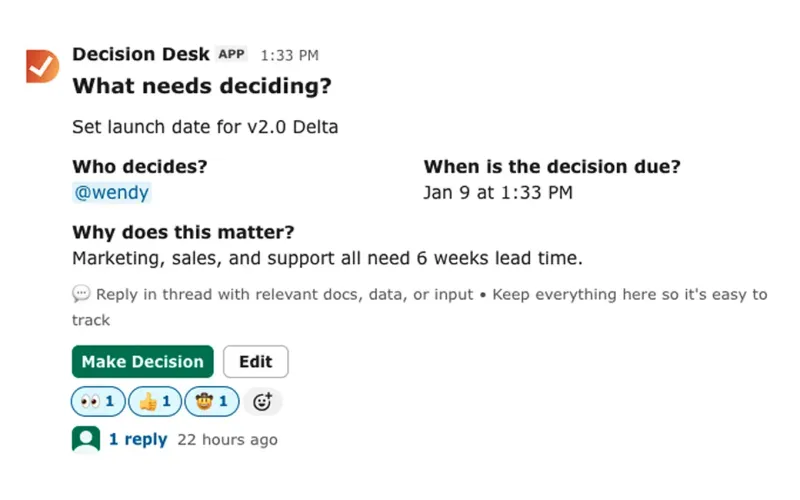
What needs to be decided.
Who will decide it.
When it must be decided by.
Once a decision is visible, it gets made.
That’s how teams move from endless debate to real momentum.
You’ve Been in This Room
You know the meeting type.
Everyone’s engaged. Many opinions. The notes are long. The topic is important. Lot's to discuss.
But the clock runs out, and no one says, “Let’s decide.”
The next week, the same topic returns. The same points resurface. The same debate is back, now frustration begins to build.
A few people think a decision was made. Others assume it’s still open.
No one knows what stage they’re in—are we debating, deciding, or communicating?
It’s the same confusion Kim Scott talks about in Radical Candor: when clarity fades, so does accountability.
The team has fallen into what we call the debate loop. Endless motion without closure or resolution.
The truth is, most teams don’t lack courage or alignment.
They just lack a visible mechanism to say, “This conversation needs a decision.”
That single moment changes everything.
The Cost of Circling
Every unmade decision carries a cost.
Sometimes it’s visible, like a delayed project. Sometimes it’s hidden like team frustration or missed opportunity. Something is building and it is not good, but no one can put their finger on it. But it's gaining momentum.
Without closure, people keep things half-done “just in case.” No one wants to move forward until someone calls it and takes responsibility.
Leaders lose visibility. They see discussion as progress, unaware that decisions are stuck.
Meetings multiply while timelines slip and busy work is happening, but not real work.
Teams lose motivation. It’s hard to stay engaged when every conversation ends with “let’s revisit.”
The signal becomes clear: decisions don’t happen here. People begin to question what is the purpose of this project or situation if no one is willing to make a decision. No decision, no progress.
That’s the real cost; not inefficiency, but erosion of trust in progress itself.

The Turning Point
Every team eventually reaches a moment when someone says the magical words:
“We’ve been circling this too long. Let’s make a decision.”
That sentence cuts through noise.
It marks the boundary between discussion and action. In that moment, clarity becomes the goal, not consensus, not more debate, not one more data point.
And once teams start saying it consistently, they realize how much time they used to lose.
Decision Desk exists to make that moment visible and repeatable. Make it easy. Make it into a habit.
It gives teams a shared rhythm: when something’s looping, log it, assign ownership, and give it a date.
That’s how progress becomes predictable again.
How We Make Decisions Happen
Here’s how teams use Decision Desk to ensure decisions actually get made.
Capture the moment something needs a decision
Don’t wait for consensus. When a topic keeps circling, capture it in Decision Desk.
Record what must be decided, who will decide, and when the decision must be made.
That single action moves the conversation from “someday” to “by Friday 12pm.”
Give every decision a deadline
A decision without a due date is a conversation on repeat. Decision Desk adds a decision-by date to every record.
It creates momentum by turning discussion into commitment.
When the date arrives, the owner is reminded and the loop ends in a call.
Name the decision maker
Without ownership, accountability dissolves. Decision Desk makes the decision maker visible to everyone.
That transparency builds trust and speeds alignment. Everyone knows who decides and when.
Capture the context behind the call
Every decision has reasoning, the trade-offs, priorities, and constraints that shaped it.
Decision Desk stores that context next to the decision.
So months later, when you revisit a topic, the “why” is right there.
Practice closure
Once teams get used to logging decisions, they stop letting conversations drift.
Someone always asks, “Should this be a decision?”
That’s how decision hygiene becomes second nature.
The Impact
Once decisions start getting made consistently, everything else accelerates.
Projects move faster.
Meetings end sooner.
Teams feel confident again because there’s a visible end to every open loop.
We’ve seen teams cut cycle times in half just by adding visibility and ownership to decisions.
No extra headcount. Just clarity.
That’s what Decision Desk delivers; not complexity, but commitment.
Make the Call
Every organization has dozens of decisions waiting to be made.
They’re sitting in meetings, threads, and inboxes, silently slowing everything down.
Decision Desk helps you surface them, assign ownership, set a decision-by date, and capture the context behind each one.
The next time your team starts looping, say the words that move work forward: “Let’s make a decision.”
Then log it.
Because once it’s visible, it gets done.

Progress moves at the speed of decisions.