Decision Desk app coming soon. Thanks for being early.

Inherited decision debt (and the cost of paying for someone else’s choices)

Understanding decision debt in leadership and how it compounds over time

Date: October 21, 2025

You can always feel when you’ve inherited decision debt.
You start a new role, take over a project, or step into a system that looks fine on the surface.

Then you start asking questions and realize no one remembers why things are the way they are. You’re not solving new problems. You’re paying for old ones.

That is inherited decision debt: the price you pay for choices made without documentation, clarity, or context.

The people who made those decisions have moved on, but the cost of figuring them out still lands on your desk.

Takeaways:

  • Inherited decisions cost more than new ones.

  • Lack of context is the most expensive part of turnover.

  • Visibility beats guesswork.

  • Paying down old decisions starts with curiosity, not blame.

Table of Contents

Frame 1 (39).webp
Frame 1 (40).webp
Frame 1 (39).webp

What Is Inherited Decision Debt

Inherited decision debt happens when you take over work built on choices that no one remembers making.

At the time, those decisions probably made sense. Deadlines were close. Growth was fast. People made quick calls and moved on. But when those people leave, they take their reasoning with them.

Now the decisions stay, but the context is gone. You see it in every department.
-A process that no one questions because “it’s how we’ve always done it.”
-A tool that no one picked but everyone depends on.
-A policy that lingers because no one feels safe changing it.

The problem isn’t the past decision itself. It’s the missing story behind it.

When teams grow without a way to record and revisit decisions, they end up carrying invisible weight from people who are no longer around.

That is inherited decision debt, and it slows down even the best teams.

Principle1/5
media _ speaker, sound, audio, music, volume, increase, decrease.png

Why It Shows Up Everywhere

Inherited decision debt builds quietly. It’s not created by bad leadership or poor systems. It’s created by speed.

When teams are growing, clarity takes a back seat to delivery. You do what works. You make fast calls. You move on. Documenting why something was done feels like a luxury.

But the moment someone new joins, all of that context becomes valuable again.

The debt shows up in little ways:

  • You spend half a meeting explaining a decision no one remembers making.

  • A new leader questions a process that made sense three reorgs ago.

  • A new team inherits systems built on assumptions no one wrote down.

The debt grows each time a person leaves or a process changes without explanation.

Before long, no one knows why anything looks the way it does.


Principle2/5
communication, messages _ chat, message, conversation, text, talk.png

The Cost of Lost Context

The real cost of inherited decision debt isn’t money. It’s time and trust.

When people can’t see why a decision was made, they either redo it or hesitate to touch it. Both slow you down.

Projects stall while teams rebuild context. Managers spend their first months trying to understand history before making progress.
New hires feel uncertain because every process looks arbitrary.

And that uncertainty spreads.

When teams stop trusting old decisions, they stop trusting new ones too.

We’ve seen this up close:

  • A leadership team reopens the same strategic debate twice in one year because the first decision was never recorded.

  • A product team spends months maintaining code they don’t understand because no one documented why a shortcut existed.

  • An operations manager inherits a process that breaks at scale but is afraid to fix it because no one knows its original intent.

Those are all forms of the same problem. Decisions without context become invisible constraints.

You end up managing ghosts — logic that no one remembers, but everyone follows.


Principle3/5
communication, messages _ chat, message, conversation, talk, type, typing.png

When Teams Finally Notice

Every company hits a point where the cost of inherited debt becomes too obvious to ignore.

It usually starts with a new person asking simple questions:

  • “Why do we use this system?”

  • “Who owns this process?”

  • “Is this still how we do things?”

Silence follows. Everyone looks around, trying to remember who decided what and when.

That silence is the sound of decision debt coming due.

We’ve sat in those meetings. Smart, capable people rebuilding history because no one left a record.


It’s not that anyone failed. It’s that the organization outgrew its memory.

For some teams, this realization comes after a missed deadline or an audit.
For others, it happens when turnover exposes how fragile institutional knowledge really is.

The moment you realize you’re paying for someone else’s decisions is the moment you decide to fix it.


Principle4/5
communication, chat _ messaging, message, conversation, talk, text.png

How to Pay It Down

You can’t rewrite the past, but you can stop reliving it. Paying down inherited decision debt starts with visibility.

Once decisions are visible, they can be clarified, challenged, or reinforced.

Here’s how teams do it with Decision Desk.

  1. Start capturing decisions now
    Don’t wait for perfect systems or templates.
    Every time a call is made, record it.
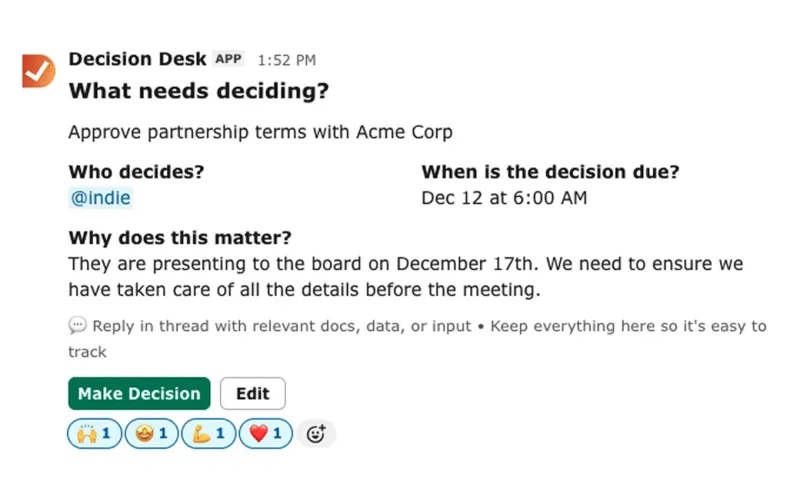
    What was decided. Who decided it. When it was made. Why it mattered.
    Future teams will thank you.

  2. Log inherited decisions as you find them
    When you uncover an old rule or workflow that no one owns, log it as “inherited.”
    You might not know its full story yet, but now you have a place to store what you discover.

  3. Add context over time
    Decision Desk lets you attach background notes, files, and reasoning as you learn more.
    Context builds gradually instead of being lost again.

  4. Assign ownership to old decisions
    Someone needs to decide whether to keep, update, or retire each inherited choice.
    Without ownership, every decision eventually becomes debt again.

  5. Create permission to question history
    Good teams evolve decisions instead of protecting them.
    When it’s normal to ask “Does this still make sense?”, decision debt stops compounding.


Principle5/5
media _ sound, speaker, audio, music, volume, increase, decrease.png

What Happens When You Stop Paying Interest

Once decisions are recorded and visible, everything changes.

  1. New hires onboard faster because they understand not just what to do, but why.

  2. Managers can make informed changes without guessing.

  3. Teams stop repeating old debates because the reasoning is documented.

Most importantly, the organization starts trusting itself again.

One company told us, “We finally stopped tripping over our own history.”
That’s the turning point. When clarity replaces confusion, inherited debt turns into shared learning.

Every recorded decision becomes a building block for better ones. You don’t erase the past; you make it understandable.

And that is how companies grow without losing themselves along the way.


SLA-appIcon-desktop.png

Make Every Decision Count

Inherited decision debt is unavoidable, but it doesn’t have to stay invisible.
The key is to make every decision findable, explainable, and owned.

Decision Desk gives teams that shared memory.
It turns decisions from fleeting moments into lasting assets — with context, ownership, and timing all in one place.

If you’ve ever spent days trying to understand why something exists, start small.
Capture one inherited decision today.

Write what you know, assign an owner, and give it a deadline date.

That’s how you stop paying interest on someone else’s choices.

Learn More

Frequently asked questions

What is inherited decision debt?

Inherited decision debt is the cost your team bears when past choices were made without clarity, documentation, or ownership — and now you’re paying for them.

Why does inherited decision debt show up in new roles and projects?

Because the people who made those decisions rarely left full reasoning behind them. New teams inherit systems, workflows, or policies they don’t understand, which creates confusion and hidden costs.

What are the real costs of carrying decision debt?

Decision debt shows up as wasted meetings, stalled projects, unnecessary rebuilds, and eroded trust. When context is missing, teams either hesitate or redo work, slowing progress across the organization.

How can teams start paying down inherited decision debt?

Start by making decisions visible. Capture what was decided, who decided it, when, and why. Then assign ownership to review, retain, or retire each inherited decision. Visibility turns old choices into manageable assets.

How does ownership help stop decision debt from compounding?

When each decision has a clearly named owner who confirms whether it still applies, ambiguity disappears. That accountability keeps decisions from silently carrying over to new projects or new teams.

Why isn’t documenting decisions enough on its own?

Because without context and clarity — the “why” behind the decision — documentation becomes shelfware. Visibility plus purpose is what turns decisions into durable, reusable knowledge.

Progress moves at the speed of decisions.

Get smarter about how decisions really get made.

Short, practical lessons on clarity, ownership, and follow-through — written by people who’ve been in the room.

Error

By submitting your email you agree to our Privacy Policy (see footer).

Cookie Settings
We use cookies to improve your experience. Manage your preferences below.

Cookie Settings

We use cookies to improve user experience. Choose what cookie categories you allow us to use. You can read more about our Cookie Policy by clicking on Cookie Policy below.

These cookies enable strictly necessary cookies for security, language support and verification of identity. These cookies can’t be disabled.

These cookies collect data to remember choices users make to improve and give a better user experience. Disabling can cause some parts of the site to not work properly.

These cookies help us to understand how visitors interact with our website, help us measure and analyze traffic to improve our service.

These cookies help us to better deliver marketing content and customized ads.