Decision Desk app coming soon. Thanks for being early.

What Is Decision Debt (And Why It Quietly Costs You More Than You Think)

Fast decisions feel efficient until they start slowing you down.

Date: October 25, 2025

Takeaways: 

  • Every decision deserves daylight. If it’s not written, it’s already fading.

  • Context is currency. Protect it like data.

  • Ownership beats consensus. Clarity moves faster than democracy.

  • Revisit without shame. Good teams evolve decisions, not enshrine them.

  • Tools should fade into habit. The system should feel like muscle memory, not management.

Table of Contents

Frame 1 (39).webp
Frame 1 (40).webp
Frame 1 (39).webp

7 min read


What Is Decision Debt?

We’ve all made fast decisions to keep things moving — a shortcut here, a quick agreement there, a temporary process that somehow becomes permanent. It’s part of growing and scaling. You don’t always have time to overthink; you just need to decide and go.

But there’s a hidden cost to those choices, one that doesn’t show up in budgets or sprint retros, but eventually hits every team.

That cost is decision debt.

Decision debt is the accumulated burden of past decisions made quickly, with incomplete information, or without long-term visibility.
You “borrow” speed back then but now, you’re paying interest in the form of confusion, rework, and misalignment.

It’s the decision-making equivalent of technical debt in software. A little is fine, even necessary.

But if you never revisit it, clarify it, or document it, that debt compounds and suddenly your organization is slower, not faster.

In simple terms:

Decision debt happens when yesterday’s choices make today’s decisions harder.

You can feel it in the hesitation before a meeting, the “wait, didn’t we already decide this?” moments, or the projects that lose momentum because no one’s sure who owns what.

That’s decision debt and it’s everywhere.


Principle1/5
media _ speaker, sound, audio, music, volume, increase, decrease.png

You’ve Felt This Before

Think about the last time your team tried to move something forward.
You’re in a meeting, the goal is clear, but the conversation derails into déjà vu.

Didn’t we already choose this approach?
Wasn’t there a decision in that doc from six months ago?
Who signed off on this last time?

Everyone looks around, half-remembering what happened, half-unsure whether the last decision still stands.
Ten minutes of confusion becomes thirty. The meeting ends with, “Let’s circle back once we confirm what was decided.”

That’s the invisible tax of decision debt.

We’ve seen it across product, ops, marketing, and leadership teams.
You lose hours not because people are unproductive but because the context of past decisions is missing.

The Frustration Loop

It starts small:

  • A project manager leaves, taking their notes and reasoning with them.

  • A new hire inherits a process they don’t understand.

  • Someone changes direction “because it makes sense now” — unaware of the constraints that shaped the first decision.

Soon, everyone’s rebuilding logic that once existed.
Not because they want to, but because they have to.

We’ve worked with teams who discovered they’d spent entire quarters debating strategies that had already been decided — twice.

They weren’t careless. They were working without a map.


Principle2/5
communication, messages _ chat, message, conversation, text, talk.png

The Interest You Keep Paying

Like financial debt, decision debt isn’t inherently bad.

Sometimes you take it on intentionally to move faster.
But the problem is when you forget to pay it down when those temporary decisions become invisible defaults.

Let’s look at what that “interest” really costs you.

Rework

  • When decisions aren’t captured or shared, teams end up revisiting the same issues again and again.

  • Meetings get longer. Slack threads go in circles. Projects stall while people “double check.” And that means your most expensive resource, your team’s time is quietly being spent rediscovering history.

  • We’ve seen teams lose 20–30% of their operational velocity this way.
    Not because of poor performance but because decisions evaporate.

Misalignment

Decision debt erodes alignment faster than almost anything else.

Different teams make well-intentioned choices in isolation, unaware of existing context.
One team commits to a plan. Another makes a conflicting call.

By the time the disconnect surfaces, both sides have invested effort and neither wants to undo their work. Alignment doesn’t just depend on communication. It depends on shared memory. Without it, even great communication becomes noise.

Complexity

Every undocumented decision adds a layer of invisible complexity to your systems and workflows. It’s why onboarding new people takes longer than you expect.
They’re not just learning tools or processes — they’re reverse-engineering logic.

We once talked to a company where onboarding included a phrase you never want to hear:

“No one really knows why we do it that way, we just do.”

That’s not culture; that’s accumulated confusion.

Delay

Decision debt slows down future decisions.
When people don’t know what’s been decided before — or whether a decision still stands — they hesitate.

No one wants to make a wrong call, so everything waits for “clarity” that never comes.
Momentum dies not from inaction, but from uncertainty.

Cultural Drag

The worst cost is cultural. When people can’t see the reasoning behind decisions, they stop trusting them. They disengage.

You hear quiet phrases like, “It’s above my pay grade,” or “That’s just how leadership decided it.”

Decision opacity breeds passivity.

And that’s how companies that once moved fast start moving in slow motion — not because they lost talent, but because they lost clarity.


Principle3/5
communication, messages _ chat, message, conversation, talk, type, typing.png

Types of Decision Debt

Not all decision debt looks the same.

Here’s how it tends to show up:

  1. Process DebtUnclear or inconsistent workflows.Each region handles onboarding differently.

  2. Context DebtMissing rationale behind choices.“Why did we choose this vendor?” — no one remembers.

  3. Ownership DebtNo clear accountability.Teams stall waiting for someone else to decide.

  4. Cultural DebtTolerance for fuzzy decisions.“We’ll decide later” becomes a habit.

Every type adds friction to your organization.


But together, they form a pattern: decisions made faster than they’re remembered. And that’s what kills momentum.

The Math of Lost Clarity

We often underestimate how expensive rework and confusion really are.

Say your team spends 5 hours a week revisiting unclear decisions:
At scale — across 40 people — that’s 800 hours a month. Nearly 5 full-time weeks of lost productivity.
Not from bad work but from unremembered work.

This is why decision debt isn’t a soft problem. It’s a hidden operational cost.

Operations Teams

Decision: “We’ll use this spreadsheet until we find a better system.”
Debt: Two years later, that spreadsheet is the system.
Each team maintains their own version. Data conflicts multiply. No one trusts the numbers.

Leadership Teams

Decision: “Let’s reorganize departments — we’ll define roles later.”
Debt: Ambiguity turns into turf wars and duplicated effort.
People spend more time clarifying authority than executing strategy.


Principle4/5
communication, chat _ messaging, message, conversation, talk, text.png

The Moment Teams Wake Up

There’s always a moment when the cost of decision debt becomes impossible to ignore. It usually starts with a sense of déjà vu, a project that feels harder than it should be, or a leader asking a question that no one can cleanly answer.

“Wait… who actually decided this?”

That silence? That’s the sound of accumulated decision debt being called in.

We’ve been in those meetings.
Everyone’s well-intentioned, competent, and exhausted.
You realize that half your effort isn’t going into the work itself — it’s going into reconstructing the reasoning behind the work.

For some teams, this realization comes during an audit or a leadership change.
For others, it’s when new hires start asking simple questions that no one can answer without Slack archaeology.

Either way, it’s humbling.

The Human Cost of Lost Context

When we lose decision context, we also lose confidence.
New managers hesitate to act because they don’t want to undo something sacred.


Team leads over-communicate, hoping to create certainty through repetition.
And the longer it goes on, the more invisible the drag becomes like a slow leak in a tire.

We once worked with a global ops team that had twenty-three “active initiatives.”
Half of them existed purely because no one wanted to challenge past decisions.
No one could prove why those initiatives started, so killing them felt risky.
That’s what decision debt does, it makes indecision safer than action.

The turning point came when one of their VPs finally said it out loud:

“If we can’t explain why something exists, it doesn’t deserve our effort.”

That became their new rule and the start of paying down their debt.


Principle5/5
media _ sound, speaker, audio, music, volume, increase, decrease.png

How We Pay Down Decision Debt

At Decision Desk, we believe clarity is a cultural muscle, one you can build deliberately. It is not easy but it is possible.

Here’s how teams do it in practice:

1. Make Every Decision Explicit

Write it down.
Not in a massive document, but in a single source of truth where everyone can find it.

Include five things:

  1. What was decided

  2. Why it was decided

  3. What alternatives were considered

  4. Who owns the decision

  5. When to review it again

It takes two minutes, but it saves weeks of confusion later.

This is the foundation of Decision Desk, a space where every decision has context, ownership, and traceability.

So when someone new joins, they inherit clarity, not mystery.

2. The More You Capture, The Better You Decide

Every recorded decision makes the next one clearer.

Teams that start logging decisions in Decision Desk quickly build the habit of framing them better — defining the real question, the trade-offs, and the context that matters.

Over time, those records become a feedback loop. You can see how you’ve decided before, what worked, and where patterns repeat.

It’s not about classifying decisions — it’s about getting better at making them by learning from your own history.

3. Capture Decisions Before They Disappear

Most tools record outcomes after the fact. But real velocity comes from tracking the moment of choice — while it’s still forming.

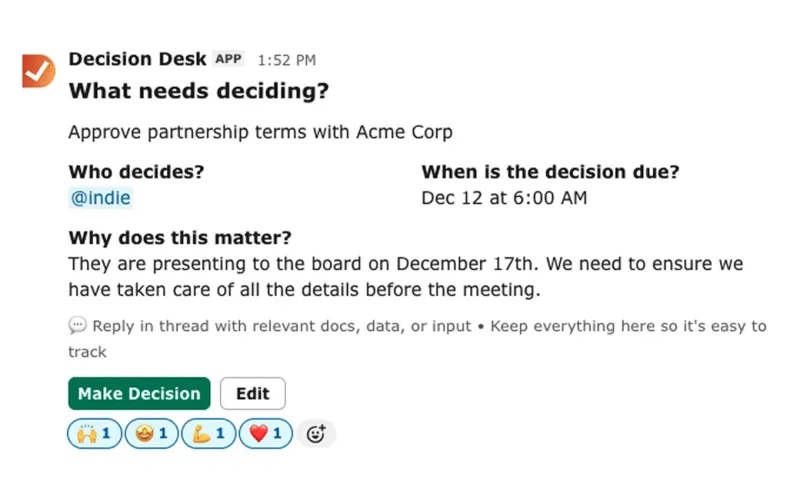
In Decision Desk, every decision starts with four essentials:

  1. The Decision — what’s being decided.

  2. The Decision Maker — who owns the call.

  3. The Deadline — when it needs to be made by.

  4. The Context — why it matters, what trade-offs exist, and what’s at stake.

It’s not paperwork — it’s decision clarity in real time.

Instead of losing these details in a Slack thread or meeting note, teams enter them directly into Decision Desk. The platform anchors that decision in time, ownership, and urgency.
When the deadline hits, you know whether a call was made and if not, who needs to make it.

That one record can save a dozen follow-ups, and it creates a visible trail of reasoning for anyone joining the project later.

4. Make Ownership and Timing Visible

Unclear ownership is the quiet killer of progress.
When nobody knows who decides or by when, decisions stall, drift, and die.

Decision Desk eliminates that ambiguity.
Every decision record has:

  • A named decision maker, visible to everyone involved.

  • A decision-by date, turning abstract urgency into a concrete timeline.

  • A context field, so anyone can understand the reasoning instantly.

This does two things:

  1. It gives the decision maker authority and accountability.

  2. It gives everyone else confidence that momentum won’t fade.

No more endless “checking in” or forgotten action items.
When a deadline approaches, Decision Desk surfaces it automatically — keeping teams aligned and focused on the next clear choice.

Because when ownership and timing are visible, follow-through becomes culture, not chaos.

5. Build “Decision Hygiene” Into the Culture

Great teams don’t just make decisions — they clean up after them.
At the end of every meeting, ask three simple questions:

  1. What did we actually decide?

  2. Who owns it?

  3. When will we review or measure it?

When those questions become second nature, your organization shifts from reactionary to intentional.

Meetings end with closure instead of uncertainty.
And people leave knowing what’s next.

6. Pay It Down During Transitions

Decision debt compounds during turnover.
When someone leaves, conduct decision handoff interviews — not just HR exit interviews.

Ask:

  • Which decisions are you the context holder for?

  • Where are the fragile or undocumented choices?

  • What should the next person know before changing anything?

Decision Desk provides an audit trail for this.
When a team member moves on, their decision history stays behind, complete with rationale and linked outcomes.


That’s how institutional memory becomes institutional clarity.

                                          

SLA-appIcon-desktop.png

Make Every Decision Count

Decision debt happens quietly. But clarity can be just as contagious.

At Decision Desk, we’ve seen what happens when teams start logging decisions with context and ownership.

Alignment sharpens. Meetings shorten. Confidence returns.
You stop paying interest on old choices and start compounding momentum instead.

If your team’s tired of repeating history, start small:

  • Document one decision today.

  • Capture the why, the who, and the when.

That’s the first payment toward decision clarity.

And when you’re ready to make it automatic, we built Decision Desk to help you do exactly that.

A simple, shared place where decisions live — long after the meeting ends.

Because the best decisions aren’t just made — they’re remembered.

Frequently asked questions

What is decision debt?

Decision debt is the cost your organization pays when decisions are delayed, ownership is unclear, and every new step reopens old uncertainty.

How is decision debt different from technical debt?

Technical debt builds when code shortcuts pile up. Decision debt builds when choices stay unresolved or undocumented. You feel it in meetings that repeat the same discussion, projects that stall, and work that quietly loses purpose.

Why does decision debt accumulate in teams?

Because decisions aren’t written down, owners change, and context disappears. Each new person has to rediscover the “why,” so the same topics resurface over and over again.

What are the real costs of decision debt?

The costs are subtle but steep: duplicated work, long cycles, onboarding delays, and a loss of confidence when no one knows why things were done a certain way.

How can teams start reducing decision debt?

Start small: make decisions visible, assign clear owners, record the “why,” and revisit open items monthly. Treat each recorded decision as living knowledge, not a frozen document.

How does using DecisionDesk help with decision debt?

DecisionDesk keeps decisions visible, assigns owners automatically, and tracks follow-through inside Slack. That makes it easy to retire old choices, confirm new ones, and stop debt from quietly accumulating.

Progress moves at the speed of decisions.

Get smarter about how decisions really get made.

Short, practical lessons on clarity, ownership, and follow-through — written by people who’ve been in the room.

Error

By submitting your email you agree to our Privacy Policy (see footer).

Cookie Settings
We use cookies to improve your experience. Manage your preferences below.

Cookie Settings

We use cookies to improve user experience. Choose what cookie categories you allow us to use. You can read more about our Cookie Policy by clicking on Cookie Policy below.

These cookies enable strictly necessary cookies for security, language support and verification of identity. These cookies can’t be disabled.

These cookies collect data to remember choices users make to improve and give a better user experience. Disabling can cause some parts of the site to not work properly.

These cookies help us to understand how visitors interact with our website, help us measure and analyze traffic to improve our service.

These cookies help us to better deliver marketing content and customized ads.