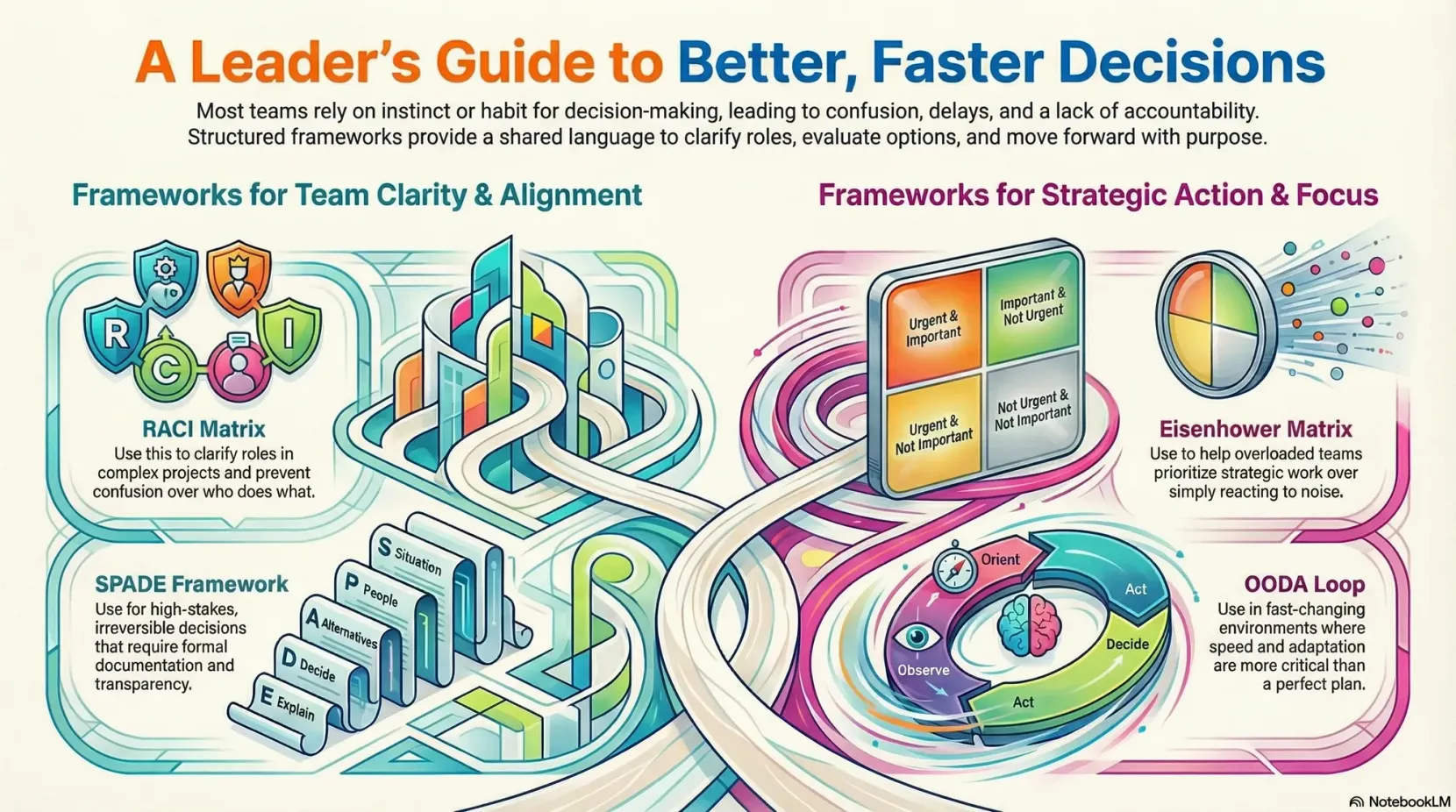
The 20 Decision-Making Frameworks Every Leader Should Know
Practical models, guiding questions, and real-world examples to make faster, clearer, and more accountable decisions.
Last updated: January 7, 2026
Introduction
We make decisions all day — in meetings, Slack threads, and hallway conversations. Some are small and reversible. Others define the next six months of work. Yet most teams still rely on instinct, hierarchy, or habit instead of a structured way to decide.
That’s where decision-making frameworks come in. These are not rigid systems — they’re shared languages that help teams clarify who decides, how to evaluate options, and how to move forward without endless debate.
The 20 frameworks below represent the most widely used approaches in modern organizations — from Bain’s RAPID and Atlassian’s DACI to SPADE, OODA, and the Eisenhower Matrix. Each section explains the framework in plain language and includes 10 key questions that surface the reasoning behind better decisions.
The goal: to help you find the right structure for each decision — and build a culture where ownership, transparency, and follow-through are the default, not the exception.
1. RAPID (Bain & Company)
Definition:
RAPID stands for Recommend, Agree, Input, Decide, Perform. It was created by Bain & Company to clarify roles in complex, cross-functional decisions. Each step defines who contributes, who approves, and who ultimately decides—so decisions don’t get stuck in meetings or diluted by consensus.
Why Use It:
RAPID brings order to ambiguity. It’s ideal when many teams must weigh in but authority must stay clear. It prevents “decision drift,” where everyone participates but no one feels responsible for follow-through.
10 Questions to Ask When Using RAPID
Who recommends the action?
Clarify who builds the initial proposal. Without a clear recommender, discussions stay theoretical and slow.
Who must agree before moving forward?
Agreement holders often control risk or resources. Identifying them early avoids late-stage vetoes.
Whose input is essential, even if they don’t approve?
Inputs improve quality. They’re voices to hear, not hurdles to clear. Balance inclusion with speed.
Who actually decides?
The single “D” owner closes the loop. If it’s not explicit, decisions get revisited endlessly.
Who performs once the decision is made?
Assign the executor immediately so accountability doesn’t evaporate after the meeting.
Has each role acknowledged their part?
Silent assumptions kill velocity. Confirm ownership verbally or in writing.
Are we over-populating the Agree or Input roles?
Too many reviewers slow progress. Trim participation to those who add unique value.
What’s the timeline from Recommend → Decide?
Time-boxing forces momentum and protects focus.
How will we document the final call?
Post the outcome in Slack or a decision log—visibility keeps teams aligned.
What’s our follow-up rhythm?
Schedule check-ins so the “Perform” step gets real traction.
2. DACI (Atlassian Model)
Definition:
DACI defines four roles—Driver, Approver, Contributors, Informed—used by Atlassian and other agile teams to clarify ownership without stifling collaboration. It ensures that one person drives progress, one person approves, and everyone else knows their part.
Why Use It:
DACI reduces confusion in product and cross-functional decisions. It scales well for remote teams because roles are visible and decisions are logged where work happens (e.g., Slack or Confluence).
10 Questions to Ask When Using DACI
Who’s the Driver pushing this forward daily?
The Driver maintains momentum, schedules reviews, and prevents drift.
Who’s the single Approver?
Only one final authority should exist. Multiple approvers create gridlock.
Which Contributors hold key knowledge?
Surface domain experts early so insight shapes direction, not fixes mistakes.
Who needs to stay Informed?
Keep transparency high by looping in affected teams without inviting extra decision-makers.
Where will we track this decision?
Centralizing in Slack threads or docs keeps DACI roles visible.
Have we defined what “done” means?
Ambiguity around outcomes leads to endless iteration.
What’s our escalation path if the Driver stalls?
Healthy escalation keeps timelines intact without blame.
Are Contributors empowered or sidelined?
Real collaboration demands active input, not after-the-fact approval.
When should we re-evaluate the Approver?
As priorities shift, authority might move; review quarterly.
How will we announce and archive the decision?
Posting a “Decision:” message summarizing DACI roles cements accountability.
3. RACI Matrix
Definition:
RACI stands for Responsible, Accountable, Consulted, Informed—a simple chart mapping who does the work, who owns the result, who’s consulted, and who must be kept aware. It’s a universal clarity tool for project governance.
Why Use It:
RACI works when multiple teams collaborate but overlap causes confusion. It makes delegation explicit, avoids duplicated effort, and prevents “too many cooks.”
10 Questions to Ask When Using RACI
Who’s Responsible for each task?
List real names—not roles—so action is traceable.
Who’s truly Accountable for the final result?
There can be only one; accountability cannot be shared.
Who must be Consulted before action?
Early consultation avoids expensive reversals later.
Who simply needs to be Informed?
Sharing context builds trust even when involvement is minimal.
Does every task have an R and an A?
Missing either means unclear execution or ownership.
Are we over-consulting?
Too many Cs delay progress; streamline for speed.
Where is the RACI chart visible?
Visibility converts governance from theory to practice.
How often will we review it?
Update when team structures or priorities shift.
What happens if Accountable and Responsible differ in opinion?
Clarify escalation rules before conflict occurs.
How do we close the feedback loop?
Share outcomes so everyone sees the impact of their role.
4. OODA Loop (Observe–Orient–Decide–Act)
Definition:
Developed by U.S. Air Force Colonel John Boyd, the OODA Loop helps leaders make fast, adaptive decisions under uncertainty. You continuously Observe reality, Orient to new data, Decide on a course, and Act—then repeat as conditions change.
Why Use It:
OODA is powerful in dynamic environments—startups, incident response, or competitive markets—where speed and iteration beat perfect plans.
10 Questions to Ask When Using OODA
What are we observing right now?
Ground decisions in facts, not assumptions. Data beats drama.
What biases or filters shape our orientation?
Awareness of blind spots sharpens judgment.
What patterns or shifts are emerging?
Spotting inflection points early gives teams advantage.
What options do we realistically have?
Clarity reduces paralysis; write them down.
Which decision moves us fastest toward our goal?
Prioritize momentum over perfection.
What’s our threshold for revisiting the decision?
Build in review points to avoid stubbornness.
Who monitors new observations after we act?
Assign someone to watch signals and update the loop.
How short can we make each cycle?
Shorter loops equal faster learning.
How do we communicate the loop to others?
Shared language prevents fragmented responses.
What did we learn from the last loop?
Debriefing turns experience into advantage.
5. SPADE (Netflix / Gokul Rajaram)
Definition:
SPADE stands for Situation, People, Alternatives, Decide, Explain. Created by Gokul Rajaram and popularized at Netflix, it formalizes tough calls in transparent, written form—balancing inclusion with decisiveness.
Why Use It:
SPADE shines for high-stakes, one-way decisions where clarity and documentation matter. It gives everyone context and rationale while keeping the final decision swift and explicit.
10 Questions to Ask When Using SPADE
What’s the Situation we’re addressing?
Define the real problem, not its symptoms.
Who are the People involved?
Name contributors, approvers, and those affected. Visibility builds trust.
What Alternatives have we considered?
Listing options reduces hindsight bias and signals thoroughness.
Which criteria will guide our choice?
Agree on evaluation factors before debate intensifies.
What Decision are we making, precisely?
State it in one clear sentence; ambiguity breeds conflict.
Who owns communicating this decision?
Assign a single messenger to keep context consistent.
How will we Explain the rationale?
Transparency defuses tension and builds alignment.
Where will we record this SPADE?
Use Slack or Decision Desk to log it for future reference.
What’s our check-back window?
Schedule a follow-up to validate the outcome.
What did this SPADE teach us about how we decide?
Meta-reflection strengthens the next round of decisions.
Is your team suffering from Decision Debt?
Take the 2-minute audit.
6. Eisenhower Matrix
Definition:
The Eisenhower Matrix, named after President Dwight D. Eisenhower, helps teams prioritize work by urgency and importance. It divides tasks into four quadrants: Do Now (urgent and important), Schedule (important but not urgent), Delegate (urgent but less important), and Eliminate (neither urgent nor important).
Why Use It:
This framework forces focus. It helps leaders spend time on long-term, strategic work instead of reacting to noise. It’s ideal for overloaded teams juggling competing priorities.
10 Questions to Ask When Using the Eisenhower Matrix
Is this task urgent or just loud?
Distinguishing urgency from volume helps protect focus.
Does it contribute directly to our core goals?
If not, consider scheduling, delegating, or cutting it entirely.
Who’s best suited to handle urgent items?
Delegation accelerates delivery and reduces burnout.
What can we eliminate without consequence?
Ruthlessly clearing clutter keeps capacity free for true impact.
Are we confusing “fast” with “important”?
Busyness isn’t progress—importance should drive action.
What’s sitting in the ‘Schedule’ quadrant too long?
Deferred strategy work becomes neglected opportunity.
Are urgent tasks recurring symptoms of deeper issues?
Patterns of urgency reveal broken systems.
How do we review priorities weekly?
Regular calibration prevents drift back to firefighting.
What deserves a full stop, not a delegation?
Eliminating low-value work creates organizational clarity.
How will we communicate shifting priorities?
Transparent reprioritization builds trust across teams.
7. SWOT Analysis
Definition:
SWOT stands for Strengths, Weaknesses, Opportunities, and Threats—a timeless strategic planning tool that assesses internal capabilities and external conditions. It’s simple but powerful for framing both risks and advantages.
Why Use It:
SWOT sharpens perspective before committing resources. It’s invaluable for strategy sessions, launches, or evaluating new initiatives.
10 Questions to Ask When Using SWOT
What are our unique strengths right now?
Internal advantages often go under-recognized until named.
Which weaknesses keep resurfacing?
Persistent gaps reveal process or talent issues to fix early.
What opportunities could amplify our strengths?
Pairing strengths with opportunities multiplies impact.
Which external threats deserve our attention?
Market, technology, or regulatory changes can shift plans overnight.
Are we being honest about weaknesses?
False optimism leads to painful surprises.
Do we have data to support our SWOT?
Evidence keeps this from being an opinion exercise.
How do we prioritize within each quadrant?
Not all items weigh equally—rank by influence and urgency.
What actions link directly from this analysis?
Translate insights into a short, specific action list.
How will we revisit and update our SWOT?
Strategic landscapes evolve; quarterly reviews maintain relevance.
Who owns tracking changes in each category?
Assigning owners turns insight into accountability.
8. PDCA (Plan–Do–Check–Act)
Definition:
Also called the Deming Cycle, PDCA is a continuous-improvement framework that encourages small, iterative learning loops. Teams Plan an action, Do it, Check the results, and Act to adjust or standardize.
Why Use It:
PDCA keeps organizations adaptive. It replaces big-bang rollouts with evidence-driven progress and works well in quality management, operations, and agile development.
10 Questions to Ask When Using PDCA
What’s the goal of this cycle?
Clarity ensures experiments tie to meaningful outcomes.
What’s our initial plan or hypothesis?
Documenting assumptions enables measurable learning.
Who executes the “Do” step?
Clear ownership keeps small cycles on schedule.
What metrics define success or failure?
Without data, feedback loops collapse.
When and how will we “Check” results?
Frequent, objective review prevents blind continuation.
What lessons emerged from this iteration?
Reflection converts results into institutional memory.
Should we standardize or pivot?
Decide if findings justify expansion or redesign.
How can we communicate PDCA progress visibly?
Dashboards and summaries sustain cross-team learning.
What prevents us from completing the “Act” stage?
Many loops stall—remove bottlenecks to finish cycles.
What will we plan next based on these insights?
Each loop fuels the next improvement opportunity.
9. Decision Tree
Definition:
A Decision Tree maps options, outcomes, and probabilities visually. Each branch represents a choice, and each leaf an expected result. It’s used widely in data science, finance, and risk management to clarify trade-offs.
Why Use It:
Decision Trees simplify complex decisions by quantifying uncertainty. They make rationale transparent and comparable.
10 Questions to Ask When Using Decision Trees
What’s the primary decision we’re analyzing?
Start with a single clear question to avoid branching chaos.
What major options exist at this node?
Capture all meaningful alternatives, not just favorites.
What are the possible outcomes for each choice?
Define consequences before assigning probabilities.
What’s the estimated likelihood of each outcome?
Using data makes the tree objective, not political.
What’s the expected value or cost of each branch?
Quantify trade-offs to reveal rational choices.
How sensitive are results to our assumptions?
Scenario testing exposes fragile conclusions.
What non-numeric factors still matter?
Ethics, culture, or brand implications can outweigh math.
Who reviews and validates the model?
Cross-checks prevent biased trees.
How do we visualize this clearly for non-analysts?
Simplicity builds buy-in from wider audiences.
When should we prune or update branches?
Outdated assumptions distort future use. Keep trees alive.
10. Cost–Benefit Analysis
Definition:
Cost–Benefit Analysis (CBA) compares the total expected costs of an action against its anticipated benefits, expressed in financial or measurable terms. It’s a foundational tool for rational resource allocation.
Why Use It:
CBA transforms subjective preference into evidence-based justification. It’s especially valuable when budgets are tight or trade-offs are politically sensitive.
10 Questions to Ask When Using Cost–Benefit Analysis
What decision are we evaluating?
Define scope tightly to keep the analysis meaningful.
Which costs are direct, indirect, or hidden?
Incomplete cost lists lead to misleading results.
What benefits can we realistically quantify?
Tangible returns (time saved, revenue gained) anchor credibility.
Which intangible benefits still matter?
Morale, brand trust, and compliance can’t always be priced but deserve weight.
What’s the time horizon for costs and benefits?
Long-term versus short-term framing changes outcomes dramatically.
What discount rate or weighting will we apply?
Adjusting for risk and inflation keeps comparisons fair.
How uncertain are our estimates?
Sensitivity analysis prevents false precision.
Who validates our assumptions?
Independent review safeguards objectivity.
What’s the decision threshold—benefit-cost ratio or ROI?
Agree on success criteria before crunching numbers.
How will we communicate results to stakeholders?
A clear summary table or chart builds trust in the final call.
Stop using spreadsheets for DACI.
Automate your decision tracking in Slack with Decision Desk.
11. Cynefin Framework
Definition:
The Cynefin Framework, created by Dave Snowden, helps leaders make sense of complexity by categorizing situations into five domains: Clear, Complicated, Complex, Chaotic, and Confused. Each domain suggests a different decision approach—from best practices to experimentation.
Why Use It:
Cynefin prevents one-size-fits-all decision-making. It guides teams toward appropriate methods based on context, encouraging adaptive leadership and reducing overconfidence in uncertain environments.
10 Questions to Ask When Using Cynefin
Which domain describes our situation?
Misdiagnosis leads to wasted effort; clarity shapes action.
Are we treating a complex problem as a simple one?
Over-simplification blinds us to interdependencies.
What signals show emerging patterns?
In complexity, patterns matter more than prediction.
Should we probe, sense, or act first?
Sequence determines learning speed and success.
Where is expert analysis still valuable?
Complicated domains benefit from deep technical input.
What experiments could clarify uncertainty?
Safe-to-fail tests turn confusion into insight.
Who monitors the boundary between domains?
Conditions change—staying alert keeps responses aligned.
Are we confusing chaos with innovation?
Chaos needs stabilization, not creativity.
How do we communicate which domain we’re in?
Shared framing reduces conflict.
When do we reclassify our context?
Regular sense-checks prevent outdated strategies.
12. Pareto Principle (80/20 Rule)
Definition:
The Pareto Principle states that roughly 80% of outcomes stem from 20% of causes. In decision-making, it spotlights where focus yields the greatest leverage.
Why Use It:
It helps prioritize limited resources by finding high-impact activities, clients, or issues that create most results—or problems.
10 Questions to Ask When Using the Pareto Principle
Which 20% of actions drive most of our success?
Identify and double down.
Which 20% of issues cause most setbacks?
Fixing them frees massive capacity.
What metrics reveal these ratios clearly?
Data, not opinion, exposes leverage.
Do we spread effort evenly or strategically?
Over-democratizing focus wastes energy.
How do we protect the high-impact few?
Guard them from distraction or dilution.
Are we misjudging inputs versus outcomes?
Effort ≠ effect; measure real results.
Who identifies emerging “new 20%” priorities?
Today’s leverage may shift tomorrow.
Where are diminishing returns kicking in?
Stop when added effort brings little gain.
How can we visualize this for teams?
Pareto charts turn insight into motivation.
How often should we refresh our analysis?
Quarterly reviews maintain focus on impact.
13. Six Thinking Hats (Edward de Bono)
Definition:
This framework divides thinking into six distinct modes—White (facts), Red (feelings), Black (risks), Yellow (benefits), Green (creativity), and Blue (process)—so teams can explore decisions from all angles without confusion or personal conflict.
Why Use It:
It turns messy group debates into structured exploration, ensuring emotional, logical, and creative perspectives all get airtime.
10 Questions to Ask When Using Six Thinking Hats
Which hat are we wearing right now?
Shared focus avoids cross-talk.
Have we separated facts from feelings?
Clarifies reasoning.
What benefits can we envision (Yellow Hat)?
Builds optimism and momentum.
What risks deserve attention (Black Hat)?
Prudence tempers enthusiasm.
Where can creativity unlock alternatives (Green Hat)?
Encourages fresh thinking.
How are emotions influencing our stance (Red Hat)?
Surfacing emotion reduces hidden bias.
Who’s guiding the process (Blue Hat)?
Keeps structure intact.
Are all hats getting equal time?
Balance prevents echo chambers.
When will we switch modes?
Timing keeps energy steady.
How do we summarize insights from each hat?
Documentation turns discussion into action.
14. McKinsey’s 3 Horizons Model
Definition:
McKinsey’s Three Horizons Model helps balance short-term execution with long-term innovation by organizing initiatives into three horizons: H1 (Core business), H2 (Emerging opportunities), H3 (Future bets).
Why Use It:
It keeps leaders from over-focusing on immediate delivery or distant vision—encouraging resource allocation across time horizons for sustainable growth.
10 Questions to Ask When Using 3 Horizons
Which horizon does this initiative belong to?
Categorization clarifies investment logic.
Are we over-funding Horizon 1?
Comfort bias stifles innovation.
Who owns Horizon 2 transitions?
Mid-term execution often lacks clear champions.
What capabilities must evolve between horizons?
Bridge-building ensures continuity.
How do we measure success differently by horizon?
Metrics should match maturity stage.
When should we sunset H1 work?
Resource discipline keeps growth alive.
What experiments feed H3 learning?
Tiny bets nurture future advantage.
How do we communicate balance to stakeholders?
Transparency builds patience for long-term payoff.
Who tracks horizon allocation quarterly?
Governance prevents imbalance.
How do we celebrate progress across all three?
Recognition sustains cross-horizon energy.
15. Vroom–Yetton Decision Model
Definition:
Developed by Victor Vroom and Philip Yetton, this model determines how participative a decision should be. It weighs decision quality, commitment, time, and team capability to choose between autocratic, consultative, or group-based styles.
Why Use It:
It ensures leaders neither over-democratize nor over-centralize decisions, aligning style to context for better speed and buy-in.
10 Questions to Ask When Using Vroom–Yetton
How critical is decision quality?
High stakes may justify wider consultation.
Is team commitment essential for success?
Engagement determines implementation.
Do I have enough information to decide alone?
Self-awareness curbs ego bias.
How complex is the issue?
Complexity invites collaboration.
Is there time for group discussion?
Urgency shifts authority inward.
Will participation slow or strengthen us?
Balance speed with support.
Do team members share organizational goals?
Misalignment increases need for guidance.
What’s our history of decision outcomes?
Past data predicts effective style.
Have I clearly defined roles in this process?
Transparency sustains trust.
What decision style fits our current context best?
Adaptation beats habit every time.
16. Delphi Method
Definition:
The Delphi Method is a structured process for gathering expert opinions anonymously over multiple rounds until consensus emerges. It’s especially effective for forecasting, strategy, and risk analysis when data is uncertain or incomplete.
Why Use It:
It neutralizes group bias and hierarchy. By separating voices from status, Delphi surfaces collective intelligence while preventing domination by louder participants.
10 Questions to Ask When Using the Delphi Method
Who are the right experts to involve?
Balance diversity and relevance for strong insights.
What question or forecast are we truly testing?
Clear focus prevents vague or circular responses.
How will anonymity be maintained?
Confidentiality fosters honesty.
What format will responses take?
Structured prompts keep data comparable.
Who synthesizes each round of input?
Neutral facilitation ensures fairness.
How many rounds will we run?
Too few risks shallow insight; too many create fatigue.
What defines “consensus” in our case?
Agreement criteria shape interpretation.
How do we handle dissenting views?
Document them—they often highlight risk blind spots.
What’s our communication rhythm between rounds?
Transparency sustains engagement.
How will final insights feed into real decisions?
Closing the loop converts discussion into direction.
17. Force Field Analysis (Kurt Lewin)
Definition:
Kurt Lewin’s Force Field Analysis maps opposing forces that drive or resist change. Teams list driving forces (supporting change) and restraining forces (hindering change) to assess whether an initiative is feasible or needs reinforcement.
Why Use It:
It visualizes resistance early and clarifies what must shift for success—vital in change management and transformation decisions.
10 Questions to Ask When Using Force Field Analysis
What change are we analyzing?
Define the outcome clearly to identify relevant forces.
What forces are driving it forward?
Recognize momentum points worth amplifying.
What forces are resisting it?
Resistance reveals practical and emotional barriers.
Which forces carry the most weight?
Prioritize effort based on influence.
How can we strengthen drivers?
Invest where energy already flows.
How can we weaken resistors?
Dialogue, training, or incentives reduce friction.
Who represents each force?
Personalizing forces makes engagement strategic.
What external factors affect the balance?
Environment and timing alter success odds.
How will we visualize and share this map?
Clarity drives buy-in.
What’s our plan to shift the equilibrium?
Sustainable change comes from rebalancing—not overpowering—forces.
18. Decision Matrix (Weighted Scoring Model)
Definition:
A Decision Matrix evaluates alternatives using weighted criteria. Teams list options, assign importance to each criterion, and score options accordingly to determine the most balanced choice.
Why Use It:
It translates intuition into structured comparison—especially useful for vendor selection, hiring, or prioritizing initiatives.
10 Questions to Ask When Using Decision Matrices
What options are we comparing?
Define boundaries to avoid false choices.
What criteria matter most to success?
Align scoring to actual outcomes, not convenience.
How will we assign weights?
Weighting turns opinion into calibrated judgment.
Who contributes to scoring?
Diverse input strengthens fairness.
Are we using consistent scoring scales?
Normalization ensures math matches meaning.
Have we tested sensitivity to weights?
Slight changes can reveal fragile results.
What does the ranking tell us qualitatively?
Numbers guide—but don’t replace—judgment.
Are emotional or political factors influencing scores?
Surface bias to protect integrity.
How will we document rationale for transparency?
Traceability builds trust in the outcome.
When should we revisit this decision?
Reevaluate as assumptions evolve.
19. Kepner–Tregoe Analysis
Definition:
Developed by Charles Kepner and Benjamin Tregoe, this analytical framework separates decision-making into situation analysis, problem analysis, decision analysis, and potential problem analysis. It structures logic for clarity under pressure.
Why Use It:
It’s designed for high-stakes or technical environments where rigor and defensibility matter—engineering, operations, or crisis response.
10 Questions to Ask When Using Kepner–Tregoe
What’s the situation we’re actually solving?
Defining context prevents premature action.
What are the true objectives of this decision?
Goals anchor every analysis step.
Which alternatives meet must-have criteria?
Filters cut noise.
What risks accompany each option?
Prevention begins with anticipation.
Which option delivers the best balance of benefits and risk?
Trade-offs get explicit, not hidden.
Who validates assumptions?
Cross-checking maintains objectivity.
How will we monitor results post-decision?
Feedback keeps learning alive.
What could go wrong even if we choose well?
Contingency planning protects success.
Who owns execution and tracking?
Accountability links analysis to action.
What lessons carry forward to future decisions?
Reflection multiplies institutional competence.
20. Nudge Theory
Definition:
Nudge Theory, popularized by Richard Thaler and Cass Sunstein, uses behavioral economics to influence better choices without restricting freedom. It shapes environments (“choice architecture”) to guide decisions subtly toward beneficial outcomes.
Why Use It:
It’s invaluable in policy, product design, and leadership—helping teams or users make smarter decisions by default.
10 Questions to Ask When Using Nudge Theory
What decision behavior are we trying to change?
Specificity drives design.
What barriers or biases currently block good choices?
Identifying friction enables subtle redesign.
How can defaults encourage the right behavior?
People rarely opt out of well-set defaults.
Are we using prompts or reminders at the right time?
Timing transforms outcomes.
What feedback loops reinforce learning?
Immediate reinforcement sustains engagement.
Could transparency or simplification improve clarity?
Complexity kills follow-through.
Are we respecting autonomy?
Nudges guide, never coerce.
Who will monitor impact ethically?
Oversight keeps influence responsible.
What data signals whether the nudge works?
Behavioral metrics prove real effect.
How might this nudge backfire or fatigue users?
Empathy prevents manipulation.
Ownership & Accountability
Make sure decisions actually happen.
Why every decision needs one clear owner
Published on Medium by Decision Desk - Every strong decision starts with clear ownership and ends with accountable action.
How do I make decisions actually happen?
Learn how to assign ownership, track actions, and ensure teams decisions get done.
How to Force Accountability in Team Decisions: The Complete Adoption Guide
Your team makes a decision. Everyone agrees. You feel good. Then... nothing happens.
How Can I Assign Ownership of Decisions in a Cross-Functional Team?
A practical playbook for naming one final decider, mapping ownership by decision type, and keeping decisions visible across your team’s Slack.
Decision accountability: why teams struggle with follow-through
Learn why teams lose momentum after decisions are made — and how clear ownership, structure, and visibility build real accountability. Practical insights from project leaders who’ve lived it.
You Can't Know How You Make Decisions (But You Can Be Aware)
Mood, energy, confidence influence your decisions unconsciously. Learn how self-awareness—not frameworks—actually improves your decision-making.
Why Awareness Beats Logic in Decision-Making
Published on Medium by Decision Desk - How energy, calm, and confidence shape better choices than logic ever could.
Your Team’s Purpose Is to Decide: Why Every Organization Needs a Decision System
Clarity isn’t found in endless meetings. It’s built when decisions are made, shared, and acted on with intent.
Decisions Are Your Organization's Intellectual Capital: Treat Them Like Source Code
Organizations treat code as treasure but decisions as trash. This is backwards. Decisions contain more value than code because they last longer and shape culture.
Decision Velocity Determines Team Velocity: Why Slow Decisions Slow Everything
Your organization moves at the speed of its decisions, not its execution. Learn how to increase decision velocity and move 10x faster.
Frequently asked questions
What is a decision framework hub?
A decision framework hub is a curated library of models, methods, and tools that help teams make clear and accountable decisions. It’s designed to give you quick access to proven frameworks used by top companies so you can choose the right one for your context.
Why use decision frameworks instead of relying on intuition?
Intuition is valuable, but it’s inconsistent. Frameworks create structure and a shared language so teams can reason through complex choices together. They reduce bias and make sure every important factor gets considered.
Which decision frameworks do leading companies use most?
Companies like Amazon, Google, and Atlassian often rely on frameworks such as DACI, RACI, RAPID, SPADE, and One-Way Door thinking. Each model balances speed, clarity, and accountability in slightly different ways.
How can I choose the right framework for my team?
Start with the nature of the decision.
Use RACI when you need clear role definitions, SPADE when alignment across teams matters, and One-Way Door when a decision is irreversible or high-impact.
Match the framework to your risk level and reversibility, not just your company size.
Are decision frameworks only for large organizations?
Not at all. Smaller teams benefit even more because structure prevents confusion. Clear ownership, shared context, and explicit decision logs help startups and distributed teams move faster with less rework.
How often should teams revisit their decision frameworks?
Review your frameworks every six to twelve months. As teams grow or priorities change, some models will fit better than others. It’s normal to refine or combine frameworks as your workflow evolves.
Progress moves at the speed of decisions.
Get smarter about how decisions really get made.
Short, practical lessons on clarity, ownership, and follow-through — written by people who’ve been in the room.
We use cookies to improve user experience. Choose what cookie categories you allow us to use. You can read more about our Cookie Policy by clicking on Cookie Policy below.
These cookies enable strictly necessary cookies for security, language support and verification of identity. These cookies can’t be disabled.
These cookies collect data to remember choices users make to improve and give a better user experience. Disabling can cause some parts of the site to not work properly.
These cookies help us to understand how visitors interact with our website, help us measure and analyze traffic to improve our service.
These cookies help us to better deliver marketing content and customized ads.