Decision Desk app coming soon. Thanks for being early.

Forcing accountability (and why people avoid decisions in the first place)

Every team eventually runs into the same wall: decisions that no one wants to make.

Date: October 15, 2025

You can see it happen in meetings.
Everyone knows what needs to be decided. Everyone has opinions. But when it’s time to commit, silence fills the room.

Someone says, “Let’s get more input.” Someone else says, “Maybe leadership should weigh in.”
And the decision drifts away again.

The truth is, people often avoid decisions not because they’re lazy, but because they’re afraid.

  • Afraid of being wrong.

  • Afraid of stepping on toes.

  • Afraid of being blamed.

And in many organizations, the way authority is defined only makes that fear worse.

Decision Desk helps teams break that pattern by making decision ownership visible, explicit, and shared.

Takeaways:

  • Accountability starts with visibility, not pressure.

  • People avoid decisions when ownership and authority are unclear.

  • Psychological safety comes from structure, not slogans.

  • Decision Desk creates shared confidence by showing who decides and when.

  • A clear decision record protects people, builds trust, and drives follow-through.

Table of Contents

Frame 1 (39).webp
Frame 1 (40).webp
Frame 1 (39).webp

Why People Avoid Decisions

When you’ve worked inside organizations long enough, you start to recognize the same hesitation.
It’s not about competence. It’s about comfort. People avoid decisions for many reasons.

  • Some don’t want to take the blame if something fails.

  • Some don’t have the full information and don’t want to slow down to get it.

  • Some want to stay out of political crossfire.

  • Some are anxious about conflict or stepping on someone else’s role.

  • And some simply don’t believe they’re the ones allowed to decide.

In some companies, power itself feels mysterious. There’s a sense of a “closed room” where real decisions get made — a quiet black market of influence.

When that happens, even good people stop acting. They wait for direction. They follow signals. They protect themselves instead of leading. The result is predictable.

Important issues stay unresolved because everyone is waiting for someone else to make the call.

Principle1/5
media _ speaker, sound, audio, music, volume, increase, decrease.png

The Cost of Invisible Ownership

When no one knows who decides, accountability disappears.

You can feel it in every delayed project and every meeting that ends without clarity. Teams discuss, agree in theory, but never close the loop.

That’s not just inefficiency — it’s a leadership cost.

Every unowned decision creates a ripple:

  • Work slows because no one knows who has the final say.

  • Morale drops because people lose confidence that choices will stick.

  • Good ideas die in debate because no one feels safe to decide.

And when something does go wrong, the blame spreads fast.

Without visible ownership, everyone becomes slightly defensive. People spend more time protecting themselves than fixing the issue. The irony is that most leaders don’t want to micromanage.

They simply don’t have a system that makes ownership visible enough to trust delegation.

Decision Desk exists to make that visibility normal.


Principle2/5
communication, messages _ chat, message, conversation, text, talk.png

The Role Confusion Problem

Many teams think they have role clarity, until a real decision appears.

That’s when the confusion shows up.

  • Someone who shouldn’t be deciding takes initiative.

  • Someone who should be deciding hesitates.

  • And everyone else works around the ambiguity.

Roles might exist on paper, but in practice, they blur.

This happens when:

  • Responsibilities shift faster than job descriptions.

  • Managers assume authority instead of confirming it.

  • People are rewarded for caution, not ownership.

In that environment, accountability feels unsafe.

  • If you make a decision and it works, it’s teamwork.

  • If it fails, it’s your fault.

So people stop deciding.

Decision Desk helps teams surface that tension. When every decision is recorded with a clear owner and “decision-by” date, misalignment becomes visible.

You see instantly if the wrong person is holding the pen or if authority isn’t clear.

That single act forces the right conversation:
Who should make this call, and by when?


Principle3/5
communication, messages _ chat, message, conversation, talk, type, typing.png

How to Create Safe Accountability

Accountability works best when it feels safe, not forced. That safety comes from structure.

People step into decisions when they know:

  1. What they’re responsible for.

  2. What information they can rely on.

  3. That their decision will be documented and understood.

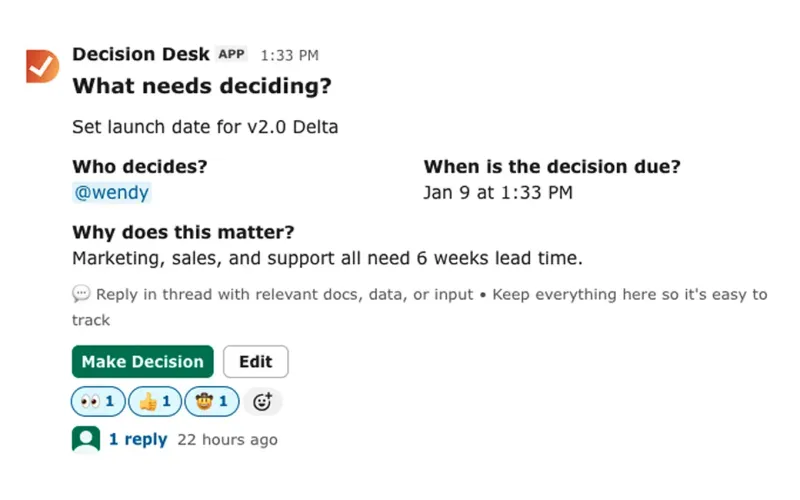
Decision Desk creates that foundation. Every decision card shows the owner, the context, the deadline, and any attached background.

When that record exists, decision-making stops feeling like personal risk and starts feeling like shared progress.

The key insight is simple:

  • When ownership is visible, accountability feels fair.

  • Leaders can see who’s deciding what.

  • Team members can see that their work ties to real decisions.

  • And when something goes wrong, you review the reasoning, not the person.

That’s what safety looks like — not the absence of accountability, but the presence of clarity.


Principle4/5
communication, chat _ messaging, message, conversation, talk, text.png

How Decision Desk Helps

Decision Desk gives teams a simple rhythm:

  1. Capture the decision

  2. Assign the owner

  3. Set the date

  4. Record the context.

This does more than track work — it changes behavior.

When people know that decisions will be visible to the whole team, they naturally start closing loops.
They prepare better. They clarify faster. They stop avoiding ownership because it’s no longer a mystery who decides.

And when ownership is misaligned, it surfaces early.
A decision log showing one person owning everything is a leadership signal.
A decision with no owner is a risk waiting to happen.
Both become visible patterns leaders can fix.

We’ve seen teams reduce stalled discussions by half just by using Decision Desk to track ownership.

Visibility breaks avoidance. It turns “someone should decide” into “I will decide.”


Principle5/5
media _ sound, speaker, audio, music, volume, increase, decrease.png

When Accountability Becomes Culture

When decision ownership becomes normal, everything speeds up.

  1. People stop asking for permission and start communicating outcomes.

  2. Leaders stop chasing follow-ups because they can see decisions in motion.

  3. Meetings end with clarity instead of caution.

The fear of blame fades because decisions are now shared, documented, and revisitable.

We worked with one operations team where accountability was a constant struggle.

  • Managers hesitated to delegate.

  • Team leads waited for top-down approval.

  • Once they started using Decision Desk, ownership became visible across projects.

Within weeks, their leadership team said the same thing: “We finally know who’s driving what.”

That’s what forcing accountability really means — not pressure, but clarity.


SLA-appIcon-desktop.png

Make Every Decision Count

Most people don’t avoid decisions because they don’t care. They avoid them because the structure doesn’t make it safe to decide.

Decision Desk fixes that by making ownership visible and shared. Every decision has a clear owner, a timeline, and context behind it.

If your team spends more time talking than deciding, start small.

  1. Capture one decision today.

  2. Name who will decide it

  3. When it’s due

  4. Why it matters

That simple act turns accountability from a burden into a habit.

Learn More

Frequently asked questions

Frequently asked questions answered

Why do people avoid making decisions in teams?

It’s rarely about apathy. Most people avoid decisions because ownership isn’t clear, authority feels fuzzy, or the fear of blame is too high. When no one feels safe or responsible, decisions quietly stall.

What is invisible ownership and why does it matter?

Invisible ownership happens when it’s unclear who has the right or responsibility to decide. The result is endless debate and slow progress — projects drift because no one knows who’s accountable.

How does role confusion affect decision accountability?

When roles overlap or change faster than decisions are documented, people hesitate to act. That hesitation compounds into recurring stalls, rework, and reactive fire-drills that keep teams from moving forward.

What does safe accountability look like in practice?

Safe accountability isn’t about pressure — it’s about clarity. When ownership, timelines, and reasoning are visible to everyone, accountability becomes a shared norm instead of a personal burden.

How can teams create visible ownership for decisions?

Capture every decision in a shared space, name an owner, set a revisit date, and record why the call was made. Visibility turns accountability from a feeling into a fact.

How does DecisionDesk help enforce accountability without adding bureaucracy?

DecisionDesk brings ownership and visibility into the tools you already use — like Slack. It makes accountability part of everyday workflow, not an extra process layer, so decisions move forward naturally.

Progress moves at the speed of decisions.

Get smarter about how decisions really get made.

Short, practical lessons on clarity, ownership, and follow-through — written by people who’ve been in the room.

Error

By submitting your email you agree to our Privacy Policy (see footer).

Cookie Settings
We use cookies to improve your experience. Manage your preferences below.

Cookie Settings

We use cookies to improve user experience. Choose what cookie categories you allow us to use. You can read more about our Cookie Policy by clicking on Cookie Policy below.

These cookies enable strictly necessary cookies for security, language support and verification of identity. These cookies can’t be disabled.

These cookies collect data to remember choices users make to improve and give a better user experience. Disabling can cause some parts of the site to not work properly.

These cookies help us to understand how visitors interact with our website, help us measure and analyze traffic to improve our service.

These cookies help us to better deliver marketing content and customized ads.