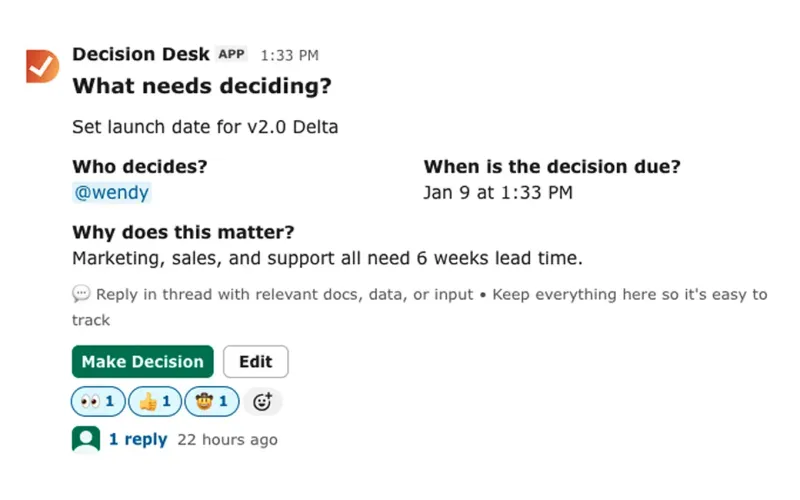
Most teams capture everything except the decisions.
You get pages of meeting notes, tasks, and ideas — but the one or two actual commitments hide between bullet points. It happens because of timing.
Decisions often come at the end of a discussion, when energy is low and people are ready to move on. Someone says, “So we’ll push the release two weeks,” and everyone nods. That’s it.
No one writes it down.
No one owns it.
No one remembers the reasoning.
By the next sync, that same discussion repeats — because the team lost the moment of decision.
You can’t prevent every loop, but you can stop the worst of them by learning to spot those moments and record them properly.
Notice when a decision is being made
This sounds obvious, but it’s a real skill.
In meetings, choices blend into conversation — you have to train yourself (and your team) to recognize the signal.
Listen for cues:
– “Let’s go with…”
– “We’ll plan to…”
– “That makes the most sense.”
– “So we’ll do X instead.”
Every time you hear one, pause and capture.
Say out loud, “Okay, let’s record that as a decision.”
It creates a cultural shift — from endless talk to tangible action.
💡 Pro tip: Assign someone as “decision recorder” for each meeting, just like a note-taker. Their only job is to log the actual choices made.
Write it as an action, not a topic
If you only record “budget” or “timeline,” you’ll forget what it meant.
Good decisions read like verbs.
Formula: Verb + Subject + Context/Constraint
Examples:
– Approve revised budget for Q2 campaign.
– Confirm launch timeline for EU rollout (pending legal).
– Decide whether to reassign design work to external partner.
This structure matters because it forces clarity:
– Verb = makes it actionable.
– Subject = defines scope.
– Context/Constraint = explains why it matters now.
When you read it later, you instantly understand what was decided, by whom, and under what conditions.
💡 Pro tip: Read your decision out loud after “We need to…”
If it sounds natural — “We need to confirm launch timeline for EU rollout” — it’s clear enough.
Capture context while it’s fresh
The decision is the headline; the context is the supporting paragraph. Without both, the record loses meaning.
Right after you record the decision, add three quick lines:
Why now: what triggered this choice?
Inputs: data or factors discussed.
Risks: what might change it later.
Example:
Why now: QA flagged stability issues; marketing launch scheduled for Friday.
Inputs: 2 open bugs, test coverage 95%, campaign assets ready.
Risk: Delay might affect partner deliverables.
It doesn’t need to be polished — just enough to help someone new understand the reasoning.
Make ownership explicit
Every decision has two sides: who owns the action and who’s accountable for the result. In meetings, those lines blur fast.
When you capture a decision, always assign one name.
“Owner: Priya.”
That doesn’t mean Priya does all the work — it means she makes sure it gets done.
Clarity about ownership turns talk into follow-through.
If a decision has multiple moving parts, assign one owner per outcome.
Never leave a decision marked “team” — teams don’t act, people do.
💡 Pro tip: Use the RACI lens quickly in your head — who’s Responsible, Accountable, Consulted, Informed — but always write down at least the first two.
Store decisions where everyone can see them
A decision hidden in someone’s notes isn’t a decision — it’s a memory.
The best teams keep a visible record:
– In a shared doc, pinned Slack post, or dedicated “Decisions” board.
– Sorted by date, topic, or meeting.
– Easy to skim.
Visibility builds trust. When people can see what’s been decided, they stop second-guessing and start executing.
At the end of each week, spend five minutes reviewing the new decisions log. You’ll catch inconsistencies early and reinforce the habit.
💡 Pro tip: Use consistent naming — start every record with “Decision:” so it’s searchable across tools.
In Decision Desk
Decision Desk was built for this exact moment — when meetings end and clarity fades.
It gives you a place to record decisions in plain language, link owners, add context, and make every choice visible.
You don’t need to replace your tools — you just need a clear record of what was decided, by whom, and why.
Decision Desk makes that the easiest part of every meeting.
Meetings should create momentum, not memory loss. When you leave the room — or end the call — the real work starts. If you capture decisions clearly, you turn conversation into action. That’s what separates meetings that matter from meetings that repeat.
Decisions only die when they’re forgotten. Write them down, make them visible, and they’ll stay alive long enough to make a difference.

Frequently asked questions
Why do meeting decisions often disappear?
Because they’re rarely treated as their own artifacts. Most teams document what was discussed — not what was decided. During a meeting, decisions are made informally, buried in conversation flow. People nod, move on, and assume someone wrote it down. Later, no one remembers the exact wording, ownership, or reasoning. The fix is to treat every decision as a separate, structured record — short, visible, and specific. When you capture it clearly in the moment, you preserve the clarity the team had when the choice was made.
What’s the best way to capture a decision?
Use a clear action statement that answers three things: what was decided, who owns it, and under what conditions.
A simple format — Verb + Subject + Context/Constraint — forces you to specify those elements:
“Approve revised budget for Q2 campaign (pending finance review).”
That single line communicates what’s changing, who’s affected, and when it takes effect. The key is to phrase it as something you can check off or confirm later. If you can’t tell whether the decision happened or not, the wording isn’t strong enough.
Who should record decisions during meetings?
Every meeting needs one designated “decision recorder.” Their role isn’t administrative — it’s operational. They listen for moments when the group crosses from discussion to decision, then document those outcomes clearly. This keeps the facilitator free to focus on flow while ensuring clarity never gets lost. In many teams, the recorder rotates weekly, but what matters is that someone always owns the capture. Over time, this habit creates a visible history of decisions that reduces repeat discussions and confusion.
How can I make sure decisions are followed up?
Follow-up happens when ownership and visibility intersect. The person who made or owns the decision must be explicitly named, and the decision itself must live somewhere public — not hidden in personal notes or DM threads. The best approach: log the decision, tag the owner, set a follow-up review date. That rhythm of record → assign → review is what turns a decision from a statement into an action. When you combine accountability with visibility, follow-through becomes a natural part of the workflow instead of an afterthought.
Where should decisions be stored?
It depends on how your team works, but the rule is simple: store them where people already look for truth. That might be a shared Google Doc, a Notion table, or a dedicated channel in Slack. The key is permanence and discoverability — if someone new joins a project, they should be able to find what was decided without asking five people. Tools like Decision Desk take this further by centralizing those decisions automatically, linking each to its owner, date, and context so they stay traceable over time.
Why is visibility important for decisions?
Because invisible decisions decay. When people can’t see what was agreed upon, they fall back into debate, redo work, or make conflicting choices. Visibility turns a decision into a shared reference point. It builds alignment, prevents rework, and keeps momentum. A visible decision says, “We’ve moved past discussion — this is our direction.” Over time, that consistency becomes cultural: teams stop measuring success by who spoke the loudest, and start measuring by how many clear, followed-through decisions they make each week.
Progress moves at the speed of decisions.