Decisions Are Your Organization's Intellectual Capital: Treat Them Like Source Code
Why the decisions your team makes are more valuable than any code, and how to protect that value.
Prefer to listen? Join the conversation.
We’ve transformed this piece into an engaging audio discussion. Hit play to hear the key insights broken down for you.
Updated: January 7, 2026
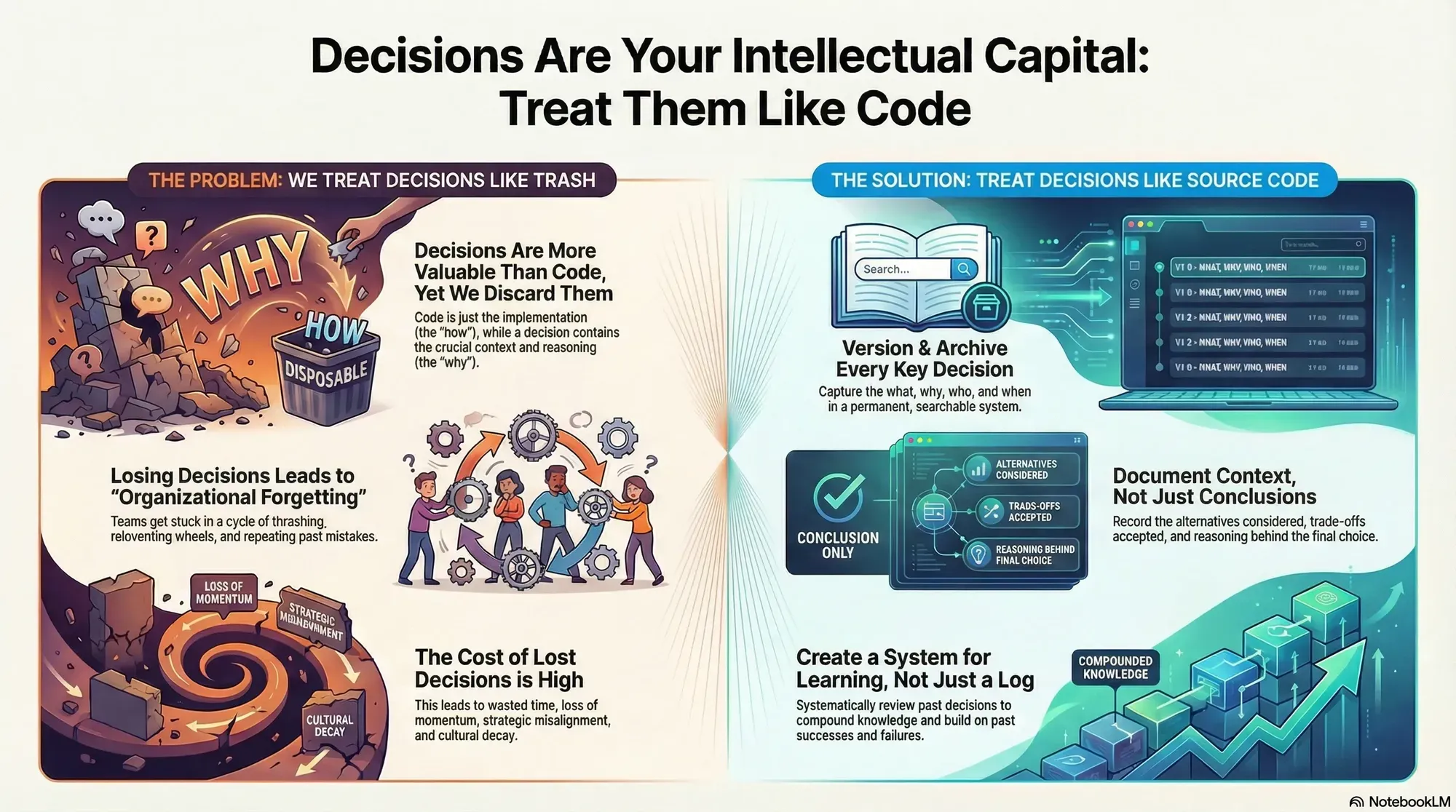
Takeaways: Organizations treat code as intellectual capital — they version it, review it, archive it, reference it, learn from it. Decisions should receive the same treatment. They're not meetings. They're not conversations. They're institutional knowledge. When decisions die, your organization's learning dies with them.
Table of Contents
The Problem: We Treat Decisions Like Trash
What Makes Intellectual Capital Valuable
Decisions Contain More Value Than Code
The Cost of Losing Decision Capital
How Source Code Treatment Works (And Why Decisions Need It)
Building a Decision Capital System
Frequently Asked Questions
The Problem: We Treat Decisions Like Trash
Imagine this: Your engineering team writes code. The code ships. Then it gets deleted.
Not archived. Not learned from. Deleted.
Every line of code disappears the moment the next version launches. New engineers join and have to re-write everything from scratch. Questions about why certain architectural choices were made? Nobody knows. You can't reference the old approach. You can't learn from it.
This would be catastrophic. We'd rebuild the same code over and over. We'd lose institutional knowledge constantly. We'd never improve because we couldn't reference our past work.
But that's exactly what organizations do with decisions.
A decision gets made. It lives in a Slack thread for a week. Then it disappears into history. A new leader joins. They ask, "What did we decide about our go-to-market strategy?" Nobody knows. The decision is gone. So they make the decision again.
Or worse: they make a different decision, contradicting the old one. The organization moves in conflicting directions.
We've decided to treat decisions like garbage.
And then we wonder why organizations can't learn. Why they keep making the same mistakes. Why they thrash between strategies.
It's not incompetence. It's a system that doesn't value decisions.
What Makes Intellectual Capital Valuable
Intellectual capital is knowledge that increases in value over time.
Code is intellectual capital because:
It's versioned — You can see every change, every iteration
It's documented — Comments explain why choices were made
It's referenced — New code builds on old patterns
It's learned from — You study past code to improve future code
It's owned — Someone is responsible for maintaining it
It's archived — Nothing is lost; everything is findable
It's reusable — Patterns from old code apply to new problems
Code gains value because the organization learns from it. Every line of code that ships represents solved problems, discovered patterns, and institutional knowledge.
Good organizations treat code like treasure.
They review it carefully. They document it thoroughly. They archive it permanently. They learn from it constantly.
Decisions should receive the same treatment.
Decisions are also intellectual capital. They represent:
Problems solved — "We evaluated three go-to-market strategies and chose direct sales because of X, Y, Z"
Patterns discovered — "When we hire in Q1, onboarding takes 12 weeks; in Q3 it takes 6"
Trade-offs understood — "We chose growth over profitability because our market window is closing"
Context captured — "We decided against open source because of data privacy concerns in our vertical"
Learning embedded — "We hired the last two people through referrals, not job boards, because conversion was 3x higher"
Every decision is a data point in your organization's learning journey.
When decisions disappear, that learning disappears.
Decisions Contain More Value Than Code
Here's what most organizations get wrong: they treat code as precious and decisions as disposable.
But decisions are more valuable than code.
Code is an implementation of a decision.
You decide to build a caching layer. You write code to implement it. The code is the how. The decision is the why.
When you reference old code, you're asking: "How did we solve this problem before?"
But what you really need to know is: "Why did we solve it that way? What were we optimizing for? What trade-offs did we accept?"
That's in the decision, not the code.
Code can be rewritten. Decisions can't. You can refactor code. You can't undo a decision from two years ago. You can only learn from it and make a better decision now.
Decisions have longer shelf lives than code.
Code gets deprecated. Frameworks change. Languages evolve. In five years, your current codebase might be completely rewritten.
But decisions last. A decision about "we will focus on enterprise over SMB" stays relevant for years. A decision about "we value speed over perfection" shapes how the organization operates forever.
Decisions shape organizational culture. Code gets replaced.
If you lose code, you lose an implementation. You can rewrite it.
If you lose a decision, you lose the learning. You lose the context. You lose the reasoning. And then you make the same decision again, often reaching a different conclusion, and your organization thrashes.
Decisions are your organization's memory. Code is just implementation.
And yet we treat code like treasure and decisions like trash.
The Cost of Losing Decision Capital
What happens when organizations don't treat decisions as intellectual capital?
Cost 1: Thrashing
The organization makes a decision. It fades from memory. Circumstances change slightly. Someone proposes a different direction. The leadership team debates whether they've already decided this. They have no record. So they re-decide.
Result: Thrashing. The organization keeps changing direction. Moving in conflicting ways. Burning cycles on re-deciding.
The cost is time, momentum, and momentum lost to employees who are confused about the actual strategy.
Cost 2: Reinventing Wheels
A team faces a problem. They've solved it before, two years ago. But they don't know that. The decision about how to solve it is lost. So they solve it again, often worse than the first time.
Result: Reinvention. The organization keeps solving problems it's already solved. Progress slows because you're not building on past learning.
Cost 3: Losing Context
A new VP joins. They ask, "Why did we choose this go-to-market strategy?" Nobody knows. The decision is lost. The new VP makes a different decision based on different logic. But the org still has investments and commitments based on the old decision.
Result: Misalignment. Different leaders making decisions based on different contexts, pulling the organization in different directions.
Cost 4: Organizational Forgetting
Decisions about "we value X over Y" shape culture. But if those decisions aren't explicit, they fade. New employees don't know them. They make decisions based on different values. The culture drifts.
Result: Cultural decay. Organizational values slip because decisions that embedded them are forgotten.
Cost 5: Slow Learning
An organization tries something. It fails. They learn from it. Or do they? If the decision isn't documented, if the reasoning isn't preserved, if the outcome isn't tracked — then they don't learn. They just know "that didn't work" without understanding why.
Six months later, a different team tries the same thing. Same failure. Same non-learning.
Result: Repeated mistakes. The organization can't learn because it doesn't preserve decision knowledge.
All of these costs stem from one thing: not treating decisions as intellectual capital.
How Source Code Treatment Works (And Why Decisions Need It)
Let's look at how organizations treat code and apply that to decisions.
Code Treatment 1: Versioning
Every change to code is versioned. You can see:
What changed
When it changed
Who changed it
Why it changed (in the commit message)
Result: You can reference any past version. You can learn how the code evolved. You can understand the reasoning behind current implementations.
Decisions need versioning too.
Track:
What was decided
When it was decided
Who decided
Why (the reasoning)
What changed (if the decision gets revisited)
Code Treatment 2: Archiving
Code is never deleted. It's archived. It stays in version control forever. If you need to reference a three-year-old approach, it's there.
Result: Nothing is lost. The organization's full history is available.
Decisions need archiving too.
Decisions should be kept forever (or at least for years). When you need to reference a three-year-old decision, it should be there.
Code Treatment 3: Documentation
Code is documented. Comments explain not just what the code does, but why it was written that way. What problem does it solve? What trade-offs were made?
Result: Future programmers can understand the code's purpose, not just its mechanics.
Decisions need documentation too.
Decisions should include:
What was decided
Why (the reasoning and context)
What alternatives were considered
What trade-offs were accepted
Who approved it
When it was made
Code Treatment 4: Reference and Reuse
Engineers reference past code. They study patterns. They apply lessons. "We solved this problem this way before — let's use that approach."
Result: The organization builds on past learning. Progress accelerates.
Decisions need reference and reuse too.
When making a new decision, leaders should reference past decisions:
"We faced a similar choice in 2021 and decided X because of Y. Does that reasoning still apply?"
"We had this trade-off debate before. Here's what we learned."
Code Treatment 5: Learning Systems
Organizations review code. They study it. They extract patterns. They learn what works and what doesn't. They improve based on what they've learned.
Result: The organization gets smarter over time. Quality improves. Efficiency improves.
Decisions need learning systems too.
Organizations should periodically review past decisions:
Which decisions led to good outcomes?
Which ones didn't?
What did we learn?
How do those lessons apply to current decisions?
Building a Decision Capital System
What would it look like to treat decisions as intellectual capital?
Step 1: Explicit Capture
Every important decision gets captured explicitly:
"DECISION: We will focus on enterprise sales over SMB market.
Reasoning: Enterprise deals are larger (3x ACV), longer sales cycles allow us to reach product-market fit, enterprise customers have higher retention.
Alternatives considered: Focus on SMB (faster to revenue but lower LTV), mixed approach (spreads focus too thin).
Owner: VP Sales. Approved by: CEO, CFO.
Date: 11/14/2025.
Revisit date: Q3 2026."
This captures everything: what, why, who, when, and even when to revisit.
Step 2: Permanent Archive
Decisions are archived permanently. They don't disappear after a week in Slack. They're stored in a system designed for long-term reference.
This could be:
A decisions database
A shared document repository
A version-controlled decisions folder
A tool designed for decision management
The point is: decisions are permanent until explicitly revisited.
Step 3: Easy Discoverability
Decisions are indexed and tagged so they're findable:
By date
By owner
By outcome
By category (go-to-market, hiring, product strategy, etc.)
By topic (sales, pricing, hiring, etc.)
When you need to reference a past decision, you can find it in seconds.
Step 4: Systematic Review
Periodically, the organization reviews past decisions:
Did it lead to good outcomes?
What did we learn?
How do those lessons apply to current challenges?
This turns decisions into a learning system, not just a record.
Step 5: Culture Shift
The organization starts treating decisions like what they are: intellectual capital.
Leaders begin sentences with: "We decided this before, here's what we learned..."
New employees learn organizational decisions as part of onboarding. They understand the why behind current practices.
When facing a new decision, people ask: "Have we decided something similar before? What did we learn?"
The Shift This Requires
Treating decisions as intellectual capital requires a mental shift.
Currently, most organizations see decisions as:
Meetings that need to happen
Conversations that need to conclude
Temporary artifacts that live in Slack then disappear
Owned by the person who makes them, not the organization
They should see decisions as:
Permanent artifacts of organizational learning
Intellectual capital that gains value over time
Owned by the organization, not by individuals
Core to organizational strategy and culture
This shift changes how leaders think about decisions.
Instead of "let me make a fast decision," they start asking: "let me make a good decision that we'll learn from and reference for years."
Instead of "who do I need to convince to get this decided," they start asking: "what context do we need, what have we learned before, and how do we document this so the organization learns from it?"
Instead of moving to the next thing, they slow down slightly to capture the learning.
That small slowdown in decision-making leads to massive speedup in organizational learning.
Why This Matters
Organizations are made of decisions.
The ones that execute well are not the ones that make the fastest decisions. They're the ones that make good decisions and build on them.
They learn from past decisions. They avoid repeating mistakes. They see patterns that apply across contexts. They improve over time.
Organizations that treat decisions as capital move faster because they're not constantly reinventing.
They're building on learning. They're compounding knowledge.
Decisions are your organization's intellectual capital.
Start treating them like it.
Version them. Archive them. Document them. Reference them. Learn from them.
That's how you build an organization that moves fast by thinking slow.
The foundation of decision capital is clear documentation. Once you have that, everything else flows.
Explore Our Guides
Practical frameworks and real-world advice for making decisions that stick.
How do I make decisions actually happen?
Learn how to assign ownership, track actions, and ensure teams decisions get done.
Decision-making frameworks: The complete guide
A practical guide to choosing and using proven decision-making frameworks—so every choice is faster, clearer, and easier to justify.
What are the best decision-making tools for Slack?
Turn Slack into your team’s decision hub with practical tools and frameworks for clarity, accountability, and visible follow-through.
Best Slack add-ons to capture and track decisions in real time
Find and follow every team decision in Slack with tools that make ownership, context, and follow-through automatic.
How Can I Assign Ownership of Decisions in a Cross-Functional Team?
A practical playbook for naming one final decider, mapping ownership by decision type, and keeping decisions visible across your team’s Slack.
Decision Desk Glossary of Decision-Making Terms
Your complete glossary of decision-making language — from DACI to follow-through — built for teams who want clarity in every choice.
Better Questions for Better Decisions
A collection of essential questions every team should ask to make faster, clearer, and more accountable decisions.
The 20 Decision-Making Frameworks Every Leader Should Know
Practical models, guiding questions, and real-world examples to make faster, clearer, and more accountable decisions.
Frequently asked questions
Doesn't treating decisions as capital slow us down?
No, it speeds you up. Yes, you spend a bit more time capturing the decision clearly. But you save vastly more time by not re-deciding things you've already decided, and by learning from past decisions instead of repeating mistakes.
The organization moves slower in the moment, faster long-term.
How long do we keep decisions?
Forever, or at least for many years. Decisions don't get stale. A decision from three years ago about "we value speed over perfection" is still relevant and valuable.
You can archive old outcomes (completed projects), but keep the decisions that informed them.
What if a decision becomes outdated?
Then you explicitly revisit it. You don't just abandon it and pretend it never happened. You document the revisitation:
"Original decision: X. Revisited: Yes, on 11/20/2025, because circumstances changed (market shift, new technology, new learning). New decision: Y. Reasoning: Z."
This creates a narrative of the decision's evolution, which is itself valuable learning.
Doesn't this create bureaucracy?
Only if you let it. The system is: clear capture, permanent archiving, easy discoverability, systematic review. That's not bureaucratic. That's organized.
Bureaucracy is when you have processes that don't serve a purpose. These processes serve the purpose of organizational learning.
How do I get my organization to adopt this?
Start with your leadership team. Document the past month of decisions explicitly. Archive them. Reference them before new meetings. Measure: "How much time did we save by not re-deciding things?"
Show the value. The rest of the organization will follow.
What about decisions that turn out to be wrong?
Keep them. Document what was learned. "We decided X, it didn't work well because Y, and now we're deciding Z instead. Here's the learning: Z was better than X because..."
Wrong decisions that are documented are worth 10 times more than right decisions that are forgotten. Because you learn from them.
Doesn't this create accountability pressure?
It can, which is good. If decisions are documented and outcomes are tracked, then leaders are accountable for quality decisions. That's not a bad thing. That's how organizations improve.
How is this different from just having a decision log?
A decision log is a record. This is a system that treats decisions as capital. It includes capture, archiving, discoverability, review, and learning. A log is passive. This system is active.
Can we do this with just Slack or email?
Technically yes, but it's fragile. Slack messages disappear or get archived. Emails get lost. To truly treat decisions as capital, you need a system designed for permanent, searchable, referenceable storage.
What's the first step?
Document your decisions explicitly for one month. Archive them in one place. Reference them before new meetings. See what changes.
Progress moves at the speed of decisions.
Get smarter about how decisions really get made.
Short, practical lessons on clarity, ownership, and follow-through — written by people who’ve been in the room.
We use cookies to improve user experience. Choose what cookie categories you allow us to use. You can read more about our Cookie Policy by clicking on Cookie Policy below.
These cookies enable strictly necessary cookies for security, language support and verification of identity. These cookies can’t be disabled.
These cookies collect data to remember choices users make to improve and give a better user experience. Disabling can cause some parts of the site to not work properly.
These cookies help us to understand how visitors interact with our website, help us measure and analyze traffic to improve our service.
These cookies help us to better deliver marketing content and customized ads.