1. Workflow focus
Cloverpop:
Create decision polls to gather input from stakeholders.
Run approval flows to get sign-off.
Announce decisions across channels.
Track results via dashboards and exporting.
Decision Desk:
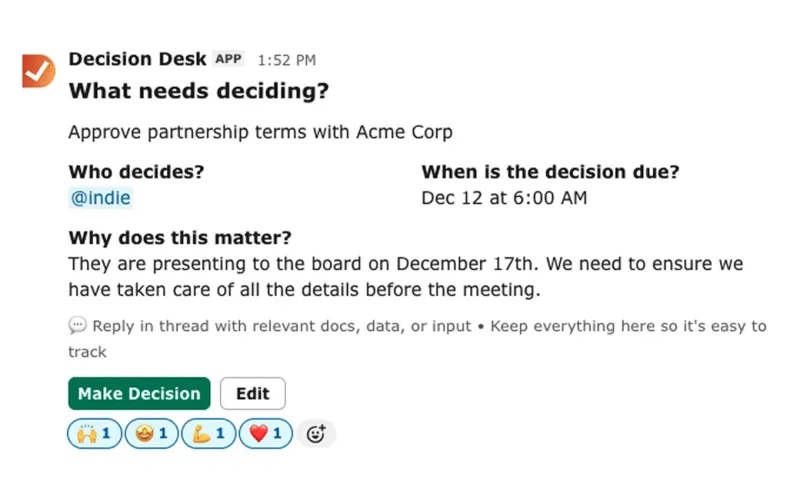
Capture decisions in Slack where the conversation already happens.
Assign one clear owner + due date + context.
When the decision is made:
an announcement posts in the same channel (so everyone sees)
the thread switches status to “Decision made”
the thread is pinned in the channel for future visibility.
Daily summary messages show pending and completed decisions.
2. Visibility & follow-through
Cloverpop:
Decision results are shared and can be rated for buy-in.
Focus on inclusive input and formal decision-making traceability.
Dashboard view for tracking decision patterns.
Decision Desk:
Decisions stay visible in the channel where they were made — no separate tool required.
Pinning ensures the decision stays in the right place, not buried.
Ownership and deadlines built into the record drive accountability.
Because you operate inside Slack, you don’t add another place to go.
3. Complexity vs simplicity
Cloverpop:
Good for teams that need templates, decision trees, structured input and analysis.
Some setup and formal process involved.
Decision Desk:
Designed to feel native in Slack. Create a decision in minutes.
No heavy forms, separate platform or analytics dashboard needed to get started.
Ideal for teams that want minimal friction and maximum clarity.
4. Tool ecosystem & integration
Cloverpop:
Integrates with Slack, Microsoft Teams, email.
Built for enterprise-scale decision intelligence and analytics.
Decision Desk:
Lives entirely in Slack, compliments existing project tools (Asana, Jira, ClickUp) without replacing them.
The thread/pin/announcement workflow links into how teams already work rather than adding another step.
Which tool fits your team?
If your workflow emphasises formal approval flows, structured polling and decision analytics, Cloverpop might align well.
If your team works mostly in Slack, values speed, clarity, ownership and wants decisions visible where work happens, Decision Desk is a strong match.
Ask: Where do your decisions live now? Are they buried in threads? Do you chase follow-up? The answer will help you pick the right workflow.
Final thought
Decisions don’t need more tools — they need more connection.
Decision Desk was built for teams that want clarity, ownership and follow-through without added process.
If your team already works in Slack and you want decisions to live and stay visible there, Decision Desk might just feel like a natural extension of your workflow.
Decision systems for teams who want clarity, ownership and follow-through.

Progress moves at the speed of decisions.